
Author

admin

Browsing

As Burger King enters the next phase of its turnaround efforts, the fast-food chain is trying to lure families back to its restaurants with colored Whopper buns and kid-friendly movie partnerships.

Starting Tuesday, the Restaurant Brands International chain will sell new menu items inspired by the “live action” remake of “How to Train Your Dragon.” The collaboration is more than just a one-time partnership — it’s part of Burger King’s broader strategy to lift U.S. sales.

“Where we’re really starting to lean in now that we’ve made some progress in both operations and in our restaurants is on a family-first marketing strategy,” Burger King U.S. and Canada President Tom Curtis told CNBC.

Burger King’s U.S. business has been in turnaround mode for more than 2½ years. After falling behind burger rivals McDonald’s and Wendy’s, the company announced plans to invest hundreds of millions of dollars in a comeback strategy to renovate its restaurants, improve its operations and spend on advertising. The chain even bought its largest U.S. franchisee with the goal of accelerating its restaurant remodels.

“We’re finding that there will be chapters to this as we go through time, and right now is this family strategy chapter, where we’ve done enough work and transformed our restaurant operations to the extent that we’re proud of,” Curtis said. “We’re inviting families back in, and we’re finding that we’re getting better retention when they do come back in.”

Curtis said focusing on families gives Burger King the opportunity to attract customers across age cohorts, from millennials to Generation Alpha, which is roughly defined as people born between 2010 and 2025. Plus, parents’ avid use of social media means that word spreads quickly, giving the approach a leg up compared with targeting a single demographic that isn’t as enthusiastic online.

The limited-time themed menu items include the Dragon Flame-Grilled Whopper, with a red and orange marbled bun; Fiery Dragon Mozzarella Fries, made with Calabrian chili pepper breading; Soaring Strawberry Lemonade; and the Viking’s Chocolate Sundae, with Hershey’s syrup and black and green cookie crumbles.

Movie collaborations aren’t anything new for fast food — or Burger King. It was one of the first fast-food chains to lean into movie tie-ins. In 1977, the chain sold “Star Wars” drinking glasses ahead of the film’s release.

McDonald’s wasn’t far behind, following with a Star Trek-themed Happy Meal two years later, kicking off decades of movie, TV and toy tie-ins aimed at kids. More recently, the Golden Arches’ collaboration with “A Minecraft Movie” across more than 100 markets sold out within two weeks in the U.S., about half the time earmarked for the promotion.

In Burger King’s more recent past, under Curtis’ leadership, the chain has had two major partnerships: one with “Spider-Man: Across the Spider-Verse” two years ago and another with the Addams Family franchise, timed for Halloween last year.

Both of those menus featured Whoppers with thematic, colored buns, dyed using natural colorants, like beet juice or ube.

“Not having artificial dyes and colors is something that’s been important to us for a while,” Curtis said.

Burger King use of natural dyes comes as artificial food dyes have come under fire from health-concerned parents. Following a push from Health and Human Services Secretary Robert F. Kennedy Jr., the Food and Drug Administration recently announced plans to phase out the use of petroleum-based synthetic dyes in food and drinks.

The two previous collaborations also were Burger King’s top-selling Whopper innovations, based on the number sold, according to Curtis.

“What we found in the Addams Family promotion specifically was, as we dug into the property, traffic was fairly flat, but sales were up,” he said, attributing the sales growth to families, which have a higher average check than a solo diner or a couple.

The expected sales lift from the “How to Train Your Dragon” menu comes at a crucial time for Burger King.

In its most recent quarter, the company’s comeback stumbled. The chain’s U.S. same-store sales slid 1.1%, mirroring an industrywide slump as fears about the economy and bad weather kept diners at home.

But Curtis is confident that Burger King is on the right track, pointing to the chain’s relative outperformance compared with its two biggest competitors: McDonald’s and Wendy’s.

“I know that they’re scrambling, and sometimes, frankly, copying some of the things that we do, which, you know, plagiarism is the sincerest form of flattery,” he said. “When we see them doing that, it gives us more conviction to stay on course.”

When the live-action version of “How to Train Your Dragon” hits theaters on June 13, it’s expected to be one of the summer’s big blockbusters. After all, the animated trilogy has grossed more than $1.6 billion worldwide.

Burger King has similar expectations for its menu tie-in.

The past success of the Spider-Verse and Addams Family menu items pushed Burger King to “dramatically” up its forecast for the “How to Train Your Dragon” menu, according to Curtis. And Burger King is also planning on changing its advertising strategy, which could drastically increase demand for the Dragon Flamed-Grilled Whoppers.

“In the past, we would just kind of associate ourselves with the movie property, but we wouldn’t necessarily advertise the association — you’d just see it and hear about it in social media,” Curtis said.

The promotion is supposed to run through early July, but in case Burger King burns through its supply in just three weeks, the chain is prepared to monitor what locations have run out of the menu items. That’s a lesson it learned during its Spider-Verse promotion, when it had to launch a tracker on its website to help customers find the coveted Whopper.

As it learns from every experience, Burger King is planning to dive deeper into franchise partnerships, betting that the extra effort will drive long-term loyalty for the brand.

“We’re doing a couple more of them than we have in the past,” Curtis said. “We’ve got one toward the end of the year that we’re very, very excited about … and we’re getting some lined up for next year as well. In every one of those, we’ll go all in.”

Disclosure: Comcast owns CNBC and Universal Studios, the producer and distributor of “How to Train Your Dragon.”

This post appeared first on NBC NEWS

If you regularly follow the SCTR Reports (StockCharts Technical Rank), you’ll notice that some top-ranked stocks aren’t just individual standouts but groupings that call attention to particular sectors, industries, or subgroups within the two.

That’s exactly what happened Tuesday morning. A couple of high-ranking stocks pointed to a growing trend in the thematic subsector of quantum computing.

Quantum Computing Stocks Light Up the SCTR Reports

Occupying the top ranks of the Mid Cap SCTR Top 10 list are quantum computing stocks D-Wave Quantum Inc. (QBTS) and Rigetti Computing, Inc. (RGTI).

FIGURE 1. SCTR REPORTS – MID CAP TOP 10. QBTS and RGTI, occupying the top of the list, signal strength in the quantum computing subsector.

The quantum computing subsector made headlines Tuesday morning, with QBTS leading the charge. 

QBTS Leads on Breakout News and Bullish Technical Scans

QBTS shares surged after the company unveiled Advantage2, its most advanced quantum system to date. A quick look at QBTS’s Symbol Summary showed the stock appearing across multiple bullish technical scans on Tuesday, including New 52-week Highs, P&F Double Top Breakout, and Runaway Gap Ups.

Other quantum names, including RGTI, also saw gains, highlighting growing momentum in the space. 

RGTI Gains Momentum with Unique Technical Setups

RGTI’s Symbol Summary profile revealed a different set of predefined scans, suggesting unique technical setups driving its price action. RGTI was triggered in the P&F Ascending Triple Top Breakout, Elder Bar Turned Blue, and P&F Double Top Breakout predefined scans on Tuesday.

With quantum computing stocks like QBTS and RGTI surging and showing unusually strong technical strength, assessing their investment potential requires more than a few headlines. Comparative strength, broader performance of sectors to which they belong, and the underlying factors shaping their price action are some other factors to consider.

FIGURE 2. PERFCHARTS OF QBTS, RGTI, XLK, AND QQQ. At these levels of outperformance, it becomes difficult to separate justified valuations from pure FOMO. As the PerfCharts comparison shows, RTGI and QBTS stocks are outperforming their sector and broader tech-heavy index. 

Technical Breakout: What to Watch with QBTS’ Next Move

From a technical perspective, does either stock present a favorable structure for a market entry? To evaluate this, let’s start with a daily chart of QBTS.

FIGURE 3. DAILY CHART OF QBTS. An impressive parabolic run, support on the downside is relatively clear.

QBTS broke out above its four-month trading range, shooting up to an all-time high of $17.50 on Tuesday’s session, sending the Relative Strength Index (RSI) deep into overbought territory. The Price Channels identify potential areas of support based on previous swing highs and lows.

If QBTS is overbought because its valuations are too high, then a pullback is likely to follow. Whether you should buy the dip depends on your fundamental thesis, but technically, if you decide to enter a position, consider this:

  • QBTS is likely to find support at the top of its previous range, highlighted in green.
  • If it falls below that, there’s another support range, shaded yellow, that marks another set of minor swing highs in the middle of the previous trading range.
  • Below that, however, is support at a low range, shaded red, where the stock has reversed several times over the last few months. 

However, if QBTS drops into the zone between the yellow and red support levels, it could signal a meaningful loss of momentum and growing weakness in the stock’s trend.

That’s why volume becomes especially important here. Note how volume has risen with each successive surge—an encouraging sign of accumulation that somehow dropped at each price peak. If QBTS holds above the top of its previous range, watch for continued volume support; strong follow-through should be backed by equally strong participation.

RGTI Chart Shows Upside Potential—But With Caution

Now let’s look at the second one up on the SCTR Top 10 list. Here’s a daily chart of RGTI.

FIGURE 4. DAILY CHART OF RGTI. The stock is moving steadily upward, but unlike QBTS, there’s no outstanding catalyst to trigger an immediate and outsize move.

Following a fourth bounce at the $7 support range, RGTI broke above resistance, almost hesitantly, at $11. The Volume-by-Price overlay on the left side of the chart shows heavy trading activity in this range, suggesting it could become a strong support level now that resistance has been broken. The ZigZag line further clarifies the support and resistance levels, helping to visualize the stock’s overall trend structure.

The On Balance Volume (OBV) indicator in the bottom panel reflects steady buying pressure. At the same time, the RSI, currently at 61 and rising, suggests the stock still has room to climb before entering overbought territory. 

If RGTI maintains its upward trajectory, the next meaningful resistance level ahead will be at $16, marking its January high. However, whether it gets there may depend less on chart patterns and more on underlying catalysts.

In other words, is RGTI riding the wave of bullish sentiment in quantum computing stocks, or does it have a meaningful fundamental catalyst driving its move higher? On that note, what about QBTS?

Wall Street Weigh In: Real Catalysts or Quantum Hype?

Be careful. Analysts are cautiously optimistic about both stocks, pointing to real catalysts like RGTI’s government partnerships and QBTS’s Advantage2 launch. However, some on Wall Street caution that recent gains may be driven more by hype than fundamentals, with commercial adoption still a long way off.

Action Steps

  • Monitor the support levels. For QBTS, watch the green zone (prior range top) for dip-buying potential; deeper moves into yellow or red zones may signal weakening momentum.
  • Track volume behavior. Continued surges should be matched with strong volume to confirm trend strength.
  • Stay grounded. If you’re trading, closely follow the technicals. If you’re investing, make sure your thesis includes realistic expectations on commercialization timelines.

At the Close

Quantum computing stocks like QBTS and RGTI are showing impressive momentum, backed by technical strength and growing investor interest. But while the setups look promising, remember to stay disciplined. Monitor support levels, watch volume closely, and don’t lose sight of the long runway ahead for true commercial adoption.


Disclaimer: This blog is for educational purposes only and should not be construed as financial advice. The ideas and strategies should never be used without first assessing your personal and financial situation, or without consulting a financial professional.

Retail traders and investors often don’t get the credit they deserve. But in April, they showed they’ve got serious market smarts. 

While headlines screamed about a tanking stock market — remember, post-Liberation Day— retail investors waited patiently. And when the time felt right, they jumped in, adding $40 billion to the stock market during the month. Just this past Monday, retail investors poured another $5.4 billion in by day’s end. That was more than a third of the day’s trading volume!

If this keeps up, May could beat April in terms of total inflows. 

Lessons From the Past

Many of you probably remember the dot-com boom and the painful bust that followed. A lot of retail traders jumped in thinking they were buying the dip. Unfortunately, the market had other plans. Many retail traders got wiped out because they ended up buying at the peak rather than the dip. 

This is the risk “buy the dip” buyers face. Sometimes it works. Sometimes it doesn’t. So, how do you protect your portfolio value, especially now that you’re managing some of your investments?

Start With a Simple Daily Routine

Taking control of your finances doesn’t mean you need to stare at a screen all day. But checking in on the market regularly can go a long way. Even a quick peek at the Market Summary page at the end of each day (or once a week) can help you stay on track.

You’ll get a snapshot of how the major indexes are performing, what their daily or weekly streaks are, and if they are above specific moving averages. Here’s a little snippet of the page. There’s a lot more to discover on the page.

An Example: Keeping Tabs on NVIDIA (NVDA)

Let’s say you bought shares of NVIDIA Corp. (NVDA) after it dipped in early April. Despite how well the stock performed in 2024, you can’t just “set it and forget it.” 

You will want to monitor how the S&P 500 ($SPX), Nasdaq ($COMPQ), and Nasdaq 100 ($NDX) are performing since NVDA is a heavily weighted stock in these indexes. 

Here’s what you can do:

  • Check the trend. Are the indexes trending higher? Are they above key moving averages? 
  • Click on the index name. Start with the daily chart and look for any red flags like a break below the 200-day simple moving average (SMA).
  • Watch the up or down streaks. If a winning streak turns into a losing one, it’s worth noting. 

Digging Deeper With Internals and Sector Insights

The Market Summary page also gives you access to market internals that can help you determine the health of the indexes. These include the Advancing/Declining Issues, Bullish Percent Index (BPI), and New Highs/New Lows, among many others. 

Since your focus is semiconductor stocks, you would closely watch the related indexes. For BPI, you’d go one step further and monitor the Technology Sector BPI ($BPINFO).

The US Industries panel displays the performance of the Semiconductors. 

What’s Up With Semis? Let’s Look at XSD

At this point, it’s worth analyzing the chart of the SPDR S&P Semiconductor ETF (XSD), the ETF included in the Market Summary page. The six-month daily chart below shows that XSD is now trading below its 200-day SMA, which is a reason for concern. 

FIGURE 1. DAILY CHART OF XSD. The ETF fell below its 200-day SMA on Wednesday and is underperforming SPY. Chart source: StockCharts.com. For educational purposes.

Note that XSD is holding on to the support of the May 12 low, which is when the price gapped up. Gaps often get filled, so a fall below where XSD closed on Wednesday could take the ETF down to the $210 level. 

In addition, the ETF’s performance relative to the S&P 500 ETF (SPY) over the last six months is at -3.96%. This indicates that semiconductors are trying hard to re-establish their pre-2025 leadership position. If XSD continues to underperform SPY, it would be more reason to be concerned.

Check In on NVDA Again

Seeing this chart should prompt you to pull up the chart of NVDA. Is the stock following the same pattern as the ETF? 

Looking at the six-month daily chart of NVDA, it’s still above its 200-day SMA, unlike XSD. However, NVDA’s stock price is flirting with the support of its May 14 low. A breach of the low could take NVDA’s stock price to its 200-day SMA or lower. This wouldn’t be good for the overall equity market because NVDA is such a heavyweight in the U.S. large-cap indexes. 

FIGURE 2. DAILY CHART OF NVDA STOCK. Wednesday’s price action suggests the possibility of a pullback. If price falls below the May 14 low, the next stop could be the 200-day SMA. Chart source: StockCharts.com. For educational purposes.

Before entering your position, you should have identified your profit target and exit point based on your risk tolerance level. Remember, when managing your investments, discipline is key.  

Keep It Simple

The Market Summary page is a tool that can help you stay ahead of the stock market without overwhelming you. 

Here is one way to use the Market Summary page: 

  • You don’t need to be glued to the screen. Just make checking in a part of your routine.
  • Know what matters. Focus on the key indexes, which direction they are trending, and the sectors you’re invested in. 
  • Engage with the market. The more you understand the price action of the market, the more empowered you become.

There are many more ways to use the Market Summary page, and we’ll be sharing more in upcoming articles. 

Bottom Line

Whether you’re hands-on with your investments, semi-retired, or retired, staying informed can help you feel confident and in control. 

So go on, check out the Market Summary page, explore the charts, and stick to your trading plan. 


Disclaimer: This blog is for educational purposes only and should not be construed as financial advice. The ideas and strategies should never be used without first assessing your own personal and financial situation, or without consulting a financial professional.

A limited amount of food was delivered to desperate Gazans for the first time since early March on Wednesday, but senior United Nations officials warned the supply was “nowhere near enough” to forestall the worsening humanitarian crisis.

UN officials say they are hoping for more to be delivered on Thursday.

Aid agencies warn that much of Gaza will be on the verge of famine if supplies are not allowed into the enclave in volume.

Until this week, Israel had forbidden all humanitarian aid entering Gaza since March 2, saying Hamas was stealing and profiting from it.

Tom Fletcher, UN under-secretary-general for humanitarian affairs, posted on X Thursday: “In close touch with team in #Gaza. Today will be crucial. Truckloads of lifesaving aid finally on move again.”

Trucks loaded with humanitarian aid began delivering the first food and supplies in Gaza in more than 11 weeks on Wednesday. More than 90 trucks carrying flour, baby supplements and other food began dispersing aid into southern Gaza, according to the head of Gaza’s transport association Nahid Shuheiber.

Kamel Ajour, the owner of the Ajour bakeries in Gaza, said some of the flour would be distributed to bakeries in the south to start working “immediately.”

Shuhaiber said he hoped for a similar number of trucks Thursday but said two trucks had been stolen by desperately hungry residents on Wednesday.

The UN Office for the Coordination of Humanitarian Affairs (OCHA) said late Wednesday that five kitchens had resumed operations in Khan Younis and Gaza City, but five others had been forced to close for a lack of supplies.

According to COGAT, the Israeli agency handling the passage of aid into Gaza, five trucks entered Gaza on Monday, 93 trucks entered on Tuesday, and another 100 entered on Wednesday.

But the head of the UN Children’s Fund, Catherine Russell, said on X Wednesday: “The few trucks that have entered with life-saving supplies are nowhere near sufficient and have yet to reach those in desperate need. We’re running out of supplies inside Gaza, and we’re running out of time.”

There have also been delays caused by disagreements between the Israeli military and aid agencies over the routes to be used within Gaza.

“Israeli authorities had only allowed our teams to go through one area where that was highly congested, that we felt was insecure and where we felt looting was highly likely to take place given the prolonged deprivation in Gaza,” said Stephane Dujarric, spokesman for the UN secretary-general, on Wednesday.

OCHA also said Wednesday that “critical items such as hygiene products or fuel have not been allowed by the Israeli authorities.”

Israel has endorsed a plan promoted by the US ambassador in Jerusalem, Mike Huckabee, for distribution of aid to be organized by a private group known as the Gaza Humanitarian Foundation. UN officials have said the plan is inadequate.

As aid begins to trickle into Gaza, Israeli forces continue to expand their operations, pushing the civilian population into a smaller area. OCHA said that “large numbers of people continue to be displaced,” with 80 per cent of Gaza now either subject to displacement orders or located in Israeli-militarized zones.

“The ongoing displacement of Gaza’s population is putting immense pressure on humanitarian teams,” OCHA said, leading to “an extreme lack of shelter space. Displacement sites and residential buildings are very overcrowded.”

UN agencies are also concerned about strikes on hospitals. It said that on Wednesday Al Awda hospital in northern Gaza – the only partially functional facility in the area – was struck, while Kamal Adwan Hospital ceased operations. The Palestinian Health Ministry said Thursday that the closure of the Indonesian Hospital in northern Gaza had deprived more than 400,000 people of health services.

In southern Gaza, the European hospital remains out of service after several Israeli strikes last week.

The International Committee for the Red Cross (ICRC) said it had received one truck of medical supplies for its field hospital in Rafah but added that it would take time to recover from the deficit created over the past ten weeks.

“The coming days are critical,” the ICRC said.

Another issue is water, with the largest desalination plant in the north of Gaza located in an area which civilians have been told to leave. Many people have moved to Al-Mawasi, a coastal area in the south, but it is not connected to the water network and relies heavily on water trucking.

This post appeared first on cnn.com

Italy’s Constitutional Court said on Thursday that same-sex female couples who use in vitro fertilization (IVF) abroad can both be legally recognized as parents in Italy, even if one is not the biological mother.

The ruling is likely to be welcomed by Italian LGBT groups who have repeatedly clashed with the conservative government of Prime Minister Giorgia Meloni, a self-declared enemy of what she and her allies call the “LGBT lobby.”

The court found that denying legal recognition to the non-biological mother violates the constitutional principles of equality and personal identity and violates the child’s rights to care, education and emotional continuity from both parents.

The decision strikes down part of a 2004 law which did not allow both women in a same-sex couple to be registered as legal mothers, even if both consented to the procedure.

Marilena Grassadonia, an LGBT rights activist from the Italian Left opposition party, said the ruling marked a “historic day” which “restores dignity and serenity to the many rainbow families who live in our country.”

The case was brought by a court in the Tuscan city of Lucca, which questioned the legality of denying “full dual parenthood” in a case involving a lesbian couple.

The judges noted that confusion over the law had led to inconsistent rulings in various courts. This has left individual mayors, who control the civil registry in their municipalities, to make differing decisions in comparable cases.

In some cases both mothers were listed on the child’s birth certificate; in others, the non-biological mother was excluded.

“These divergent outcomes reflect a shifting social reality to which the legislature has yet to respond,” the referral said.

The ruling did not alter Italy’s current restrictions on access to IVF, which is still limited to heterosexual couples, but marked a shift towards the recognition of LGBTQ parenting rights.

In a separate verdict also released on Thursday, the Constitutional Court said rules preventing single women from accessing IVF were not unconstitutional, but said they could be changed if a political will for it emerged in parliament.

This post appeared first on cnn.com

We now know who won the contest to attend an intimate dinner with President Donald Trump by buying his cryptocurrency — and he’s a familiar face to Securities and Exchange Commission regulators and law enforcement officials.

Justin Sun, a Chinese-born crypto entrepreneur, confirmed in an X post Tuesday that he was behind the account, labeled ‘SUN,’ that purchased the most $TRUMP meme coin to sit at the president’s table at a crypto-focused gala scheduled for Thursday.

‘Honored to support @POTUS and grateful for the invitation from @GetTrumpMemes to attend President Trump’s Gala Dinner as his TOP fan!’ Sun wrote. ‘As the top holder of $TRUMP, I’m excited to connect with everyone, talk crypto, and discuss the future of our industry.’

He capped the post with an American flag emoji.

Critics have blasted the dinner contest as potentially unconstitutional and a blatant opportunity for corruption. Trump has not publicly commented on the accusations, and the Office of Government Ethics has declined to comment. A White House official did not immediately respond to a request for comment Tuesday.

The Trump administration is not directly involved in administering $TRUMP coin. As for the dinner, a White House official said in a statement that the president ‘is working to secure GOOD deals for the American people, not for himself.’

‘President Trump only acts in the best interests of the American public — which is why they overwhelmingly re-elected him to this office, despite years of lies and false accusations against him and his businesses from the fake news media,” White House spokesperson Anna Kelly said.

While Trump has not been as aggressive in directly promoting cryptocurrencies as some campaign backers in the industry had hoped, his administration has abandoned or paused many pending cases that had been brought against crypto entrepreneurs and businesses.

That includes Sun, who was charged in 2023 with market manipulation and offering unregistered securities. Regulators sought various injunctions against him that would have largely prevented him from participating in crypto in the U.S. The Verge, a tech industry website, had also reported Sun was the target of an FBI investigation.

But in February, the SEC, now controlled by Trump appointees, agreed to a 60-day pause of the suit in order to seek a resolution.

Two months earlier, Sun purchased $30 million in crypto tokens from World Liberty Financial (WLF), the crypto venture backed by Trump and his family, the website Popular Information reported.

Eventually, Sun became the largest publicly known investor in World Liberty after he brought his funding total to $75 million.

According to Bloomberg News, per the terms of World Liberty’s financial structure, 75% of the proceeds of token sales like Sun’s get sent to the Trump family as a fee — meaning they may have directly earned as much as $56 million.

On Jan. 22two days after Trump was inaugurated Sun posted on X, “if I have made any money in cryptocurrency, all credit goes to President Trump.”

In April, The Wall Street Journal reported that Joe Biden’s Justice Department had been investigating Sun, noting that researchers had estimated that more than half of all illicit crypto activity took place on Sun’s Tron blockchain platform. The Journal said it wasn’t clear whether the investigation was ongoing. It said Sun’s representatives declined to comment about what they called “baseless allegations about legal matters” while denying Tron enables criminal activity.

Sun may now be a multibillionaire, with a net worth estimated at $8.5 billion, according to Forbes. He reportedly was forced to spend $2 billion to shore up one of his crypto firms that was facing collapse in 2022.

He did not immediately respond to a request for comment about what he hoped to get out of the dinner with the president.

Sun has also earned headlines for purchasing ‘Comedian,’ an art installation composed of a banana duct-taped to a wall, for $6.2 million, and for buying lunch with Warren Buffett for $4.57 million.

This post appeared first on NBC NEWS

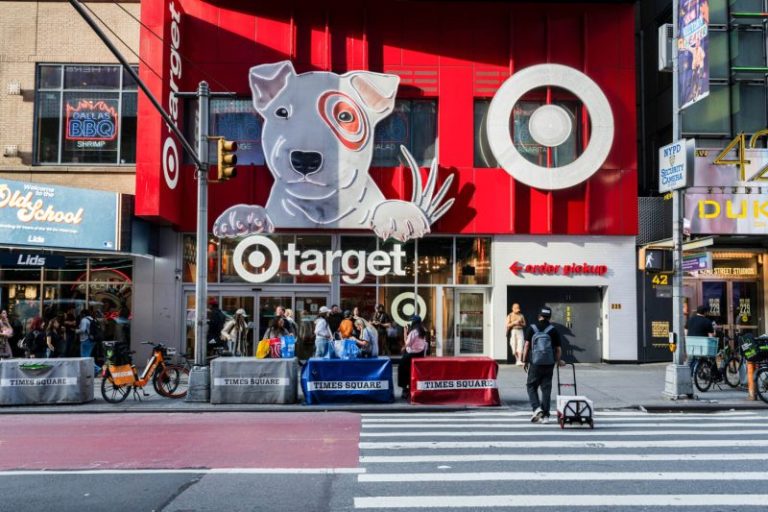
Raising prices on consumers to cover the costs of President Donald Trump’s tariffs will be Target’s ‘very last resort,’ CEO Brian Cornell said Wednesday.

The remarks came as Target reported weaker-than-expected sales in its first quarter and cut its full-year forecast. The retailer, whose business hasn’t fared as well against rivals better known for bargain prices, has “many levers to use in mitigating the impact of tariffs,” Cornell said.

Major retailers appear to be treading cautiously around the question of price hikes after Trump slammed Walmart last weekend for warning that shoppers could pay more due to tariffs. In the days since, Target, Lowe’s and Home Depot have each made carefully worded remarks about the potential for higher prices or minimized discussion of tariffs altogether.

Walmart said last week that it customers would likely start seeing some prices climb as soon as this month because tariffs have created a more “challenging environment to operate in.” While presidents typically avoid appearing to dictate individual companies’ strategies, Trump castigated Walmart on his social media platform, demanding that it “EAT THE TARIFFS” and adding, “I’ll be watching, and so will your customers!!!”

“We’ll keep prices as low as we can for as long as we can given the reality of small retail margins,” Walmart told NBC News Saturday in response to Trump’s post. Days later, Home Depot all but ruled out near-term price hikes, citing its scale and supply-chain arrangements. Lowe’s barely mentioned tariffs when it reported earnings Wednesday but said just 20% of what its shoppers buy now comes from China, after years of diversifying its sourcing.

For Target, Cornell emphasized that tariffs were just one factor in a series of “massive potential costs” the company is grappling with. He pointed to consumer uncertainty over the direction of the economy and a high-profile backlash over Target’s watering down of its diversity, equity and inclusion policies. The retailer had expanded those initiatives after police murdered George Floyd in its hometown, Minneapolis, five years ago this weekend.

Target has rolled out discounts over the past year to lure inflation-weary shoppers and touted plans to expand its third-party marketplace to offer a broader range of items. To deal with new trade policy challenges, it’s negotiating with vendors, reassessing its product lineup and adjusting its foreign supply chain, Chief Commercial Officer Rick Gomez told investors Wednesday.

‘Half of what we sell comes from the U.S.,’ he said, adding that Target is expanding production in the United States and in other countries outside of China, whose exports currently face a 30% import tax.

Target’s stock fell more than 5% Wednesday during a broader market sell-off.

Some major companies that sell products at leading retailers have raised prices or said they’re considering doing so, including toolmaker Stanley Black & Decker, consumer products giant Procter & Gamble, sportswear brand Adidas and toy maker Mattel.

Mattel, the maker of Barbie dolls, has also come under fire from Trump, who threatened to hit it with 100% tariffs this month, after it signaled price hikes were on the table.

Big companies generally have more latitude to handle cost increases and other economic headwinds than their smaller counterparts. The U.S. Chamber of Commerce and independent business owners have warned that tariffs threaten to snuff out many small operators, chipping away at the competition for already large corporate rivals.

The National Retail Federation, which represents some of the biggest retailers in the country, has emphasized that risk in lobbying against new levies. “Small and medium-sized businesses will be disproportionately affected by the tariffs, with many saying they will have to raise prices or shut down,” it says on its website.

So far, “consumers are still spending despite widespread pessimism fueled by rising tariffs,” NRF Chief Economist Jack Kleinhenz said in a statement last week after retail sales eked out a modest 0.1% rise in April.

But even the largest multinational companies aren’t insulated from tariff-driven uncertainty, the NFR and industry analysts say. Like Target, several large firms have revised or scrapped their financial outlooks in recent weeks, unsure how the White House’s trade agenda will affect them. Nike plans to increase prices on several items between now and June 1, a person familiar with the matter told NBC News on Wednesday.

Not every retailer is voicing tariff jitters. The parent company of T.J. Maxx and Marshalls beat sales estimates Wednesday and maintained its full-year forecast. The discounter, which buys unsold merchandise from other brands that have already paid tariffs on much of it, said it expects to be able to handle the pressure from higher import taxes.

Sportswear brand Canada Goose, which makes popular winter jackets, also exceeded Wall Street expectations. But it joined the slew of companies pulling their forecasts for the rest of the year, citing an “unpredictable global trade environment.”

This post appeared first on NBC NEWS

In this video, Frank dives into some of his favorite features on StockCharts.com. He then dissects the S&P 500 and Bitcoin price action, before exploring the the XLK Technology ETF’s explosive move off the lows. He also highlights a few recent trade ideas and setups worth watching. Get trade ideas and chart setups worth watching in today’s technical review.

This video originally premiered on May 20, 2025.

You can view previously recorded videos from Frank and other industry experts at this link.