Author

admin

Browsing

Apple was sued on Friday by shareholders in a proposed securities fraud class action that accused it of downplaying how long it needed to integrate advanced artificial intelligence into its Siri voice assistant, hurting iPhone sales and its stock price.

The complaint covers shareholders who suffered potentially hundreds of billions of dollars of losses in the year ending June 9, when Apple introduced several features and aesthetic improvements for its products but kept AI changes modest.

Apple did not immediately respond to requests for comment.

CEO Tim Cook, Chief Financial Officer Kevan Parekh and former CFO Luca Maestri are also defendants in the lawsuit filed in San Francisco federal court.

Shareholders led by Eric Tucker said that at its June 2024 Worldwide Developers Conference, Apple led them to believe AI would be a key driver of iPhone 16 devices, when it launched Apple Intelligence to make Siri more powerful and user-friendly. But they said the Cupertino, California-based company lacked a functional prototype of AI-based Siri features and could not reasonably believe the features would ever be ready for iPhone 16s.

Shareholders said the truth began to emerge on March 7 when Apple delayed some Siri upgrades to 2026 and continued through this year’s Worldwide Developers Conference on June 9 when Apple’s assessment of its AI progress disappointed analysts.

Apple shares have lost nearly one-fourth of their value since their Dec. 26, 2024 ,record high, wiping out approximately $900 billion of market value.

This post appeared first on NBC NEWS

Walmart has agreed to pay $10 million to settle a Federal Trade Commission civil lawsuit accusing the world’s largest retailer of ignoring warning signs that fraudsters used its money transfer services to fleece consumers out of hundreds of millions of dollars.

The settlement was filed on Friday in Chicago federal court, and requires approval by U.S. District Judge Manish Shah.

Walmart also agreed not to process money transfers it suspects are fraudulent, or help sellers and telemarketers it believes are using its services to commit fraud.

“Electronic money transfers are one of the most common ways that scammers tell consumers to send them money, because once it’s sent, it’s gone for good,” said Christopher Mufarrige, director of the FTC consumer protection bureau. “Companies that provide these services must train their employees to comply with the law and work to protect consumers.”

The Arkansas-based retailer did not admit or deny wrongdoing in agreeing to settle. Walmart did not immediately respond to requests for comment.

In its June 2022 complaint, the FTC accused Walmart of turning a blind eye to fraudsters who used its money transfer services to cash out at its stores.

Walmart acts as an agent for money transfers by companies such as MoneyGram and Western Union. Money can be hard to trace once delivered.

The FTC said fraudsters used many schemes that included impersonating Internal Revenue Service agents, impersonating family members who needed money from grandparents to avoid jail, and telling victims they won lotteries or sweepstakes but owed fees to collect their winnings.

Shah dismissed part of the FTC case last July but let the regulator pursue the remainder. Walmart appealed from that decision. Friday’s settlement would end the appeal.

This post appeared first on NBC NEWS

In the past 48 hours, the Middle East has witnessed an unprecedented US airstrike on Iran with its most powerful non-nuclear weapons, an Iranian retaliatory strike on the largest US air base in the region, to an apparent truce that will see Iran and Israel end their hostilities that have set the world on edge.

The region and the wider world watched warily as events unfolded overnight into Tuesday, but with a degree of hope as daylight broke in the region that what US President Donald Trump called the “12 Day War” may be over.

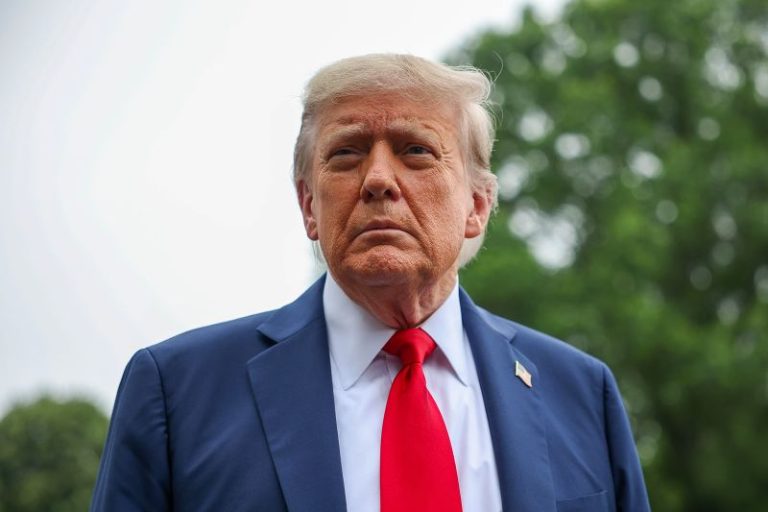
“THE CEASEFIRE IS NOW IN EFFECT. PLEASE DO NOT VIOLATE IT!” Trump wrote on his Truth Social account.

Around the same time, Israeli emergency workers were at the site of what appeared to be Iran’s final attack of the 12-day conflict, a missile strike in Beer Shiva that left at least five people dead and 20 wounded.

It could be the last hostile act of two days of whipsawing developments leading up to Trump’s surprise announcement of a ceasefire.

Here’s the situation Tuesday in the Middle East.

The ceasefire deal

On Monday evening in Washington, the US president announced the ceasefire.

“It has been fully agreed by and between Israel and Iran that there will be a Complete and Total CEASEFIRE,” Trump said in a social media post.

“I would like to congratulate both Countries, Israel and Iran, on having the Stamina, Courage, and Intelligence to end, what should be called, “THE 12 DAY WAR,” Trump said.

Trump said the ceasefire would be phased in, with Iran ending attacks on Israel first, then Israel stopping its attacks on Iran 12 hours later. But the exact timing of those events was unclear.

During the negotiations, Trump communicated directly with Israeli Prime Minister Benjamin Netanyahu, while Vice President JD Vance, Secretary of State and National Security Adviser Marco Rubio and special envoy Steve Witkoff negotiated the terms, through direct and indirect channels, with the Iranians, the source said.

Trump said in a later social media post that both Israel and Iran came to him to get a ceasefire done.

Iranian state media reported, however, that Trump sought the ceasefire deal “in a begging-like manner” after the attack on the US air base in Qatar.

Whether a ceasefire will hold remains to be seen.

Around the time Iran was supposed to have stopped its attacks under the Trump timeline, its missiles hit Israel, killing at least five civilians, according to Israeli officials.

Iran fires on biggest US base in region

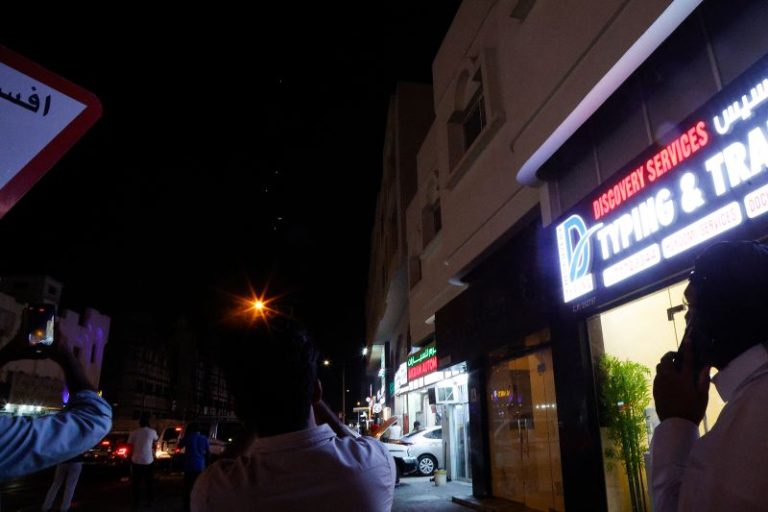
Just hours before Trump’s ceasefire announcement, Iran fired about a dozen short- and medium-range ballistic missiles at the Al Udeid Air Base in Qatar, the largest US military installation in the Middle East.

But Tehran tipped both the US and Qatar that the strike was coming, and air defenses, including Patriot missile batteries, were able to intercept all but one of the incoming Iranian missiles, according to US and Qatari officials. No deaths or injuries were reported in Qatar.

In a social media post, Trump thanked Iran for warning the missile attack was coming.

“Most importantly, they’ve gotten it all out of their ‘system,’ and there will, hopefully, be no further HATE. I want to thank Iran for giving us early notice, which made it possible for no lives to be lost, and nobody to be injured,” Trump said.

“Tehran’s choice to limit its retaliation and deescalate the crisis is rational on their part given overwhelming US strength and Iranian weakness,” said Rosemary Kelanic, director of the Middle East Program at Defense Priorities.

What about Iran’s nuclear program?

Israel’s contention that Iran would soon be able to build a nuclear weapon was the impetus for the conflict, which began with Israel Defense Forces strikes on Iranian nuclear facilities and against Iran’s military and nuclear program scientists on the night of June 12-13.

Trump followed on Israel’s airstrikes by ordering an attack on Iranian nuclear facilities, including a fleet of US B-2 bombers to dropping fourteen 30,000-pound Massive Ordnance Penetrator bombs on two deeply buried sites in Iran, the first time weapon had been used in combat.

Trump administration officials said Iran’s nuclear weapons program, which they said was just days away from the ability to make a nuclear bomb, was set back years by the US strikes.

Experts were more skeptical, saying Iranian stores of enriched uranium may have escaped destruction in the US strikes and Tehran may be able to make a weapon in just a few months.

What now for Gaza?

The Middle East has been a tinderbox since October 2023, when Hamas militants from Gaza entered Israel in force, killing hundreds and taking dozens more hostage.

Israel responded with an invasion of the Palestinian enclave to root out Hamas from tunnels and other fortifications that has left over 55,000 people dead, much of Gaza in ruins and its population of 2.1 million at risk of famine, according to the World Health Organization.

While the world’s attention has been on Israel’s fighting with Iran, dozens of people have been killed by Israeli forces in Gaza as they scramble to get the limited food aid allowed into the territory, including 21 in the past day, Palestinians say.

A group advocating for the return of Israeli hostages held in Gaza has called for the ceasefire between Israel and Iran to be expanded to include the war-torn enclave.

“Those who can achieve a ceasefire with Iran can also end the war in Gaza,” the Hostages and Missing Families Forum said in a statement Tuesday.

The forum said the ceasefire “must expand to include Gaza” and called on the government “to engage in urgent negotiations that will bring home all the hostages and end the war.”

“After 12 days and nights during which the people of Israel could not sleep because of Iran, we can finally go back to not sleeping because of the hostages,” the forum said.

Israeli opposition leader Yair Lapid echoed those sentiments, writing in a post on X: “And now Gaza. This is the moment to close that front as well. To bring the hostages home, to end the war. Israel needs to start rebuilding.”

This post appeared first on cnn.com

An empty base as a target, with many hours warning, and a limited number of missiles fired at some of the best air defense systems in the world. Iran’s retaliation for the US’s weekend strikes on three of its nuclear facilities can only have been designed to deescalate.

The US-run Al Udeid airbase in Qatar had been evacuated days earlier, with satellite images showing the departure of planes and personnel widely publicised in the media. It is the most important US military airbase in the region, the home of Central Command. It even launched the drone that killed Iran’s top military personality, General Qasem Soleimani, in 2020, Iranian state media said in the hours after “Operation Glad Tidings of Victory.” The Monday strike against Al-Udeid had close to zero chance of American casualties – and provided the perfect moment of quasi-absurd face-saving for Iran.

The first hint of a possible strike came when the US Embassy in Doha, Qatar, issued an emergency “shelter in place” order for US citizens. As if to remove any doubt, Qatar closed its airspace about an hour prior to the launch of what appears to have been close to a dozen missiles by Iran. Adding to the favourable conditions of the launch for Iran’s dwindling arsenal, Qatar is close enough to permit the use of shorter-range missiles, stocks of which have not been as depleted as the medium-range missiles used to hit Israel over the past week.

To pour water on anything resembling a flame, Iran’s National Security Council said moments after the attack the number of missiles fired had been “as many as the number of bombs used in the attack on Iranian nuclear facilities.” Packaging the barrage as the definition of a proportionate response, the Iranian statement went on to insist the attack posed “no dangerous aspect to our friendly and brotherly country of Qatar and its noble people.”

Tehran’s method of retaliation-without-fangs has been successfully tried and tested. After Soleimani was killed, Iran’s retaliatory missile attack against the US’s Al Asad airbase in Iraq was reportedly telegraphed to Baghdad beforehand, possibly helping reduce the level of US injury suffered to mostly concussions. Iran’s response to Israel’s assassination of Hamas leader Ismail Haniyeh in July 2024 in the heart of Tehran heavily telegraphed in advance.

“We knew they’d retaliate. They had a similar response after Soleimani,” a senior White House official said Monday night.

A playbook appears to be forming. But it is one that compounds Iran’s military weakness each time it is employed. In 2020, the Islamic Republic lost its pre-eminent military personality – an Iranian hardline hero. In 2024, it showed that valuable allies were not safe in central Tehran. This year, the regime has lost control of its own airspace to the point of previously unthinkable strikes on their prized nuclear facilities by both Israel and the US.

This is stark testament to the differing powers on display. Iran has to feign its strength in a managed presentation of restrained and muted anger. The US and Israel get to break taboos daily, shattering Iran’s long-held position as a regional power in under ten days, and perhaps ending its ambitions to be a nuclear power.

There is now only one real red line left for the United States or Israel to cross, and that is to directly target Iran’s Supreme Leader Ayatollah Ali Khamenei. But that may seem ill-advised, given the likelihood this octogenarian theocrat would be replaced by a younger hardliner who is keener to flex Iran’s muscles of deterrence. Better to accept toothless retaliations amid Tehran’s slow decline.

Each expression of Iran’s anger has confirmed its slow erosion of power. An angry fledging nuclear power would have accelerated its race to an atomic bomb. That may still happen. But it looks more likely that Iran is desperately hoping its performative lashing out can sate what remains of its hardliners, decimated by Israeli strikes. It may even hope to shuffle back to diplomacy, with talks to contain a nuclear program and ballistic missile stockpile likely severely depleted to shadows of what they were merely ten days ago.

This post appeared first on cnn.com

In today’s “Weekly Market Recap”, EarningsBeats.com’s Chief Market Strategist Tom Bowley looks ahead to determine the likely path for U.S. equities after the weekend bombing of Iran nuclear sites. Are crude prices heading higher? Will energy stocks outperform? What additional roadblocks might we have to negotiate after the latest Fed meeting and policy statement? Could we see fallout from June monthly options expiring on Friday? Check it all out in the video below….

Happy trading!

Tom

The S&P MidCap 400 SPDR (MDY) is trading at a moment of truth as its 5-day SMA returns to the 200-day SMA. A bearish trend signal triggered in early March. Despite a strong bounce from early April to mid May, this signal remains in force because it has yet to be proven otherwise. Today’s report will show how to quantify signals and reduce whipsaws using the percentage difference between two SMAs.

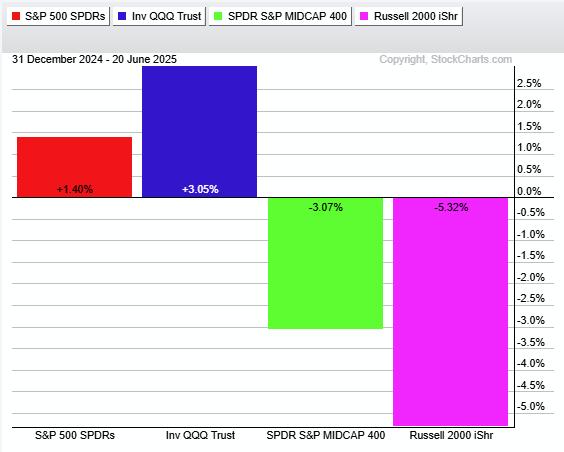
First note that MDY is lagging SPY and QQQ because its 5-day has yet to cross above its 200-day. The latter two saw bullish crosses in mid May, over a month ago. A bullish breakout in MDY would reflect broadening upside participation, which would be bullish for stocks. The PerfChart below shows SPY and QQQ with year-to-date gains. MDY and IWM are down year-to-date. 


***********************

TrendInvestorPro continues to follow the leading uptrends and recent breakouts in metals-related ETFs. These include gold, silver, palladium, platinum, copper and associated miners. Tech-related ETFs are also leading and featured in our reports/videos. Click here to learn more and get full access to our research.

***********************

The chart below shows MDY hitting its moment of truth as the 5-day SMA (black line) bumps against the underside of the 200-day SMA (blue line). A bearish cross occurred in late February and this signal has yet to be reversed. However, I am not watching for a simple 5/200 cross. Instead, I want to see the 5-day SMA clear the 200-day SMA by a certain percentage. This is a signal threshold.

The indicator window shows Percent above MA (5,200,1), which measures the percentage difference between the 5 and 200 day SMAs. See the TIP Indicator Edge Plugin for details. I placed signal thresholds at +3% and -3% to reduce whipsaws. A bullish signal triggers with a move above +3% and a bearish signal triggers with a move below -3%. At the very least, this indicator value is still negative and bearish. A move above 0 would reflect a positive 5/200 cross, while a move above +3% would trigger a bullish trend signal. This indicator is part of the TIP Indicator Edge Plugin for StockCharts ACP.

The signal threshold levels depend on your personal preferences and trading styles. Tighter thresholds generate earlier signals, but with more whipsaws. Wider thresholds reduce whipsaws, but increase signal lag. This is always the tradeoff. I prefer plus/minus 1 percent when using the 5/200 cross for SPY. I widened these thresholds to plus/minus 3 percent for MDY because it is more volatile.

TrendInvestorPro continues to follow the leading uptrends and recent breakouts in metals-related ETFs. These include gold, silver, palladium, platinum, copper and associated miners. Tech-related ETFs are also leading and featured in our reports/videos. Click here to learn more and gain immediate access. 

DY6 Metals Ltd (ASX: DY6, “DY6” or the “Company”) is pleased to announce the initial visual estimations from the reconnaissance exploration program at the Douala Basin HMS Project, Cameroon. Desktop studies incorporating detailed geological mapping, geophysics, and known mineral occurrences, were used to define initial, high priority targets for ground- truthing. The reconnaissance programme, which consisted of hand auger and channel sampling, was successful in identifying high estimated concentrations of heavy mineral (HM) mineralisation across all the six tenements that make up the project. Additionally, the Company’s consultants have observed the presence of natural rutile grains within panned concentrates.

HIGHLIGHTS

  • The Company’s reconnaissance auger and channel sampling programme has been completed at the Douala Basin HMS Project
  • Reconnaissance sampling undertaken across the 6 Douala Basin tenements has identified thick zones of high estimated concentrations of heavy minerals (HM) as well as natural rutile
  • Work at the Douala Basin Project followed up on historical HM occurrences identified by previous Eramet drilling, as well as priority areas identified through the Company’s internal reviews
  • Samples collected from the reconnaissance program are due to be submitted for laboratory analysis in the coming weeks, with results expected in the September quarter
  • At Douala Basin, exploration will transition to a detailed campaign of auger drilling

Samples collected from this initial exploration programme are currently being prepped for dispatch to the Company’s laboratory for analysis in South Africa, with results expected in the September quarter.

Technical Consultant, Cliff Fitzhenry, commented:“While the Company’s primary focus is on the Central Rutile Project, where we have recently reported the presence of wide-spread residual natural rutile mineralisation, we believe that the Douala Basin HMS project has significant potential. The reconnaissance programme has over the last few weeks demonstrated the potential of the area, with the identification of high concentrations of visible heavy mineral sands across the project tenements through a mixture of auger, channel, and soil sampling work. Pleasingly, we have also observed natural rutile grains at Douala Basin.

We look forward to the assay results of the reconnaissance programme in the coming months.”

Reconnaissance exploration at the Douala Basin HMS Project

As announced on 5 June 2025, the Company commenced reconnaissance auger and grab sampling programmes at the Central Rutile and Douala Basin HMS projects, Cameroon. At the Douala Basin project, the Company has completed 12 hand auger drill holes (refer Figure 1), collecting 53 samples in the process, as well as collected 38 channel samples from 11 surfaces for analysis (refer Tables 1 & 2).

Cautionary Statement:

The Company cautions that, with respect to any visual mineralisation indicators, visual observations and estimates of mineral abundance are uncertain in nature and should not be taken as a substitute or proxy for appropriate laboratory analysis. Visual estimates also potentially provide no information regarding impurities or deleterious physical properties relevant to valuations. Assay results from the drilling and sampling programmes will be required to understand the grade and extent of mineralisation. Initial assay results are expected in August 2025.

Click here for the full ASX Release

This post appeared first on investingnews.com

Canada’s tech sector saw momentum this week, with announcements spanning venture capital and quantum computing, as well as global policy leadership news out of the G7 summit.

Axl on a mission to retain Canadian innovation

On Tuesday (June 17), Axl, a newly founded Canadian venture studio, announced plans to help launch 50 artificial intelligence (AI) companies in Canada over the next five years, supported by a C$15 million fund led by co-founder Daniel Wigdor, a computer science professor at the University of Toronto.

The venture’s other founders are Tovi Grossman, another University of Toronto professor, entrepreneur Ray Sharma and former Telus (TSX:T,NYSE:TU) executive David Sharma. Mining magnate Rob McEwen of McEwen Mining (TSX:MUX,NYSE:MUX) and Smart Technologies co-founder David Martin are also investors.

According to Wigdor, Axl will tackle practical business problems and connect them with promising academic research in a bid to keep Canadian innovation at home. “The social contract academics believe we have with society is that we invent these technologies and inspire people,” he told the Globe and Mail on Tuesday. “The tragedy is that the foundational technologies we’re inventing in Canada are not accruing capital for Canada.’

Wigdor pointed to his own career as a cautionary tale, explaining that the iPhone’s multi-touch interface was presaged by research he conducted in the early 2000s for his University of Toronto thesis, which itself built on concepts pioneered by University of Toronto professor Bill Buxton in the 1980s.

Other University of Toronto AI breakthroughs fueled the international rise of figures like Geoffrey Hinton, OpenAI co-founder Ilya Sutskever and xAI’s Jimmy Ba, all of whom took their expertise to US-based companies.

Carney talks tech leadership at G7 summit

Initiatives like Axl’s signal a proactive approach to Canada’s challenge of retaining tech talent and capitalizing on its world-class research; however, its success will hinge on broader public support.

Prime Minister Mark Carney has signaled that fostering tech innovation at home is a priority. He told G7 leaders that driving the digital transition, led by AI and quantum computing, would be one of his top goals at the summit.

Quantum technology was reportedly discussed at length during the two day meeting, which took place in Kananaskis, Alberta. In addition, a joint statement from members released by the prime minister’s office indicates that Canada will launch the G7 GovAI Grand Challenge and host a series of Rapid Solution Labs “to develop innovative and scalable solutions to the barriers we face in adopting AI in the public sector.”

That emphasis echoes longstanding concerns from the research community.

A 2024 letter acquired by the Logic and sent to then-innovation minister François-Philippe Champagne by the Quantum Advisory Council cites the significant sums that other countries have invested in quantum technology.

“The cost of inaction is tremendous,” the group wrote at the time, pointing to Canada’s history of “inventing core technologies,” but letting other countries “grow industries around our inventions.”

The council proposed a C$1 billion program that would mirror the Quantum Benchmarking Initiative (QBI), which fosters domestic quantum computing in the US. The QBI has selected 18 companies for its first phase, including three from Canada; firms that demonstrate the ability to build a functional quantum computer by 2033 will be eligible to receive up to US$316 million, making it a potential “kingmaker” program.

The second phase of the program is set to launch in August 2025. While no relocation demands have been made, concerns exist that later-stage QBI terms could force Canadian winners to the US.

The Quantum Advisory Council said its proposed program would be run by the National Research Council, which would independently assess firms to accelerate the development of competitive domestic quantum companies.

It would build on a C$360 million national quantum strategy announced in April 2021.

The council’s recommendations include increased grants for scientific and social science research into quantum technologies, and a new federal clusters program to foster regional quantum ecosystems encompassing research, development and training, alongside ethical and secure use. It also calls for significant investment in quantum-safe software certification and the development of other security systems.

In a speech at the Quantum Now conference in Montreal on Thursday (June 19), Canada’s AI minister, Evan Solomon, emphasized the need to protect Canada’s talent pipeline. “We cannot allow short-term funding opportunities to hollow out our domestic capabilities or transfer generations of Canadian innovation outside our borders,” he said.

Earlier this month, the minister said he would move away from “over-indexing on warnings and regulation” and instead focus on finding ways to unleash the economic potential of AI. The ongoing collaboration between government initiatives and private ventures will be key to unlocking Canada’s full potential in the new digital era.

Securities Disclosure: I, Meagen Seatter, hold no direct investment interest in any company mentioned in this article.

This post appeared first on investingnews.com

It’s a Monday night in June and hundreds have braved the haze of Canadian wildfires to gather in a cavernous sports facility in the city of Red Deer, Alberta.

An Alberta team, the Edmonton Oilers, are taking on the Florida Panthers in a National Hockey League finals game tonight. The atmosphere is heavy with anticipation.

But these people aren’t here for hockey. This is a rally for Alberta independence.

It might be hard to believe, given Canadian sports fans’ recent booing of “The Star Spangled Banner,” but not all Canadians took offense to US President Donald Trump’s questioning of their country’s sovereignty.

In oil-rich Alberta, where a movement for independence from Canada appears to be gathering steam, many see in Trump a powerful and important ally whose haranguing of their former Prime Minister Justin Trudeau was as welcome as his calls to “drill baby, drill.”

Though some see US statehood as a step too far, many in the Red Deer crowd believe the US president – as a fellow pro-oil conservative – would recognize a breakaway Alberta should a vote on independence go their way.

Donald Trump is not the savior of the world,” says Albert Talsma, a welding contractor from Bentley. “But right now he’s North America’s best asset.”

With their “Make Alberta Great Again” hats, “Alberta Republic” T-shirts and posters declaring “Albertans for Alberta!” it’s not hard to see parallels to the US president’s MAGA movement and the forces that inspired it.

Separatists here have long argued that Canada’s federal system fails to represent their interests; that the federal government’s efforts to stymie climate change are holding back Alberta’s lucrative oil industry (the largest in Canada); that they pay more than they get back through federal taxation; that their conservative values are drowned out by the more liberal eastern provinces.

“Alberta hasn’t been treated fairly since 1905, when we joined Confederation. They basically used the west as a colony, to take wealth from the west to support the east,” says Kate Graham, a singing grandmother from Calgary.

She opens the rally with a rendition of Janis Joplin’s “Mercedez Benz,” the lyrics modified to promote independence. Like Janis, she sings it a cappella, before spending much of the rest of the event at a booth by the door, selling merch emblazoned with the slogan “I AM ALBERTAN.”

Similar disenchantment is voiced by a steady stream of Albertans, each venting against their mother country on a stage flanked by a large provincial flag strung across a soccer goal.

“They want to stifle our (oil) industry,” says Mitch Sylvestre, a businessman from Bonnyville and one of the rally’s chief organizers, his hoarse voice echoing over the PA system.

“We have cancer. We have a problem,” says Sylvestre. “We have it large.”

Hopes for a vote in ‘one of God’s treasures’

In a strange twist, the push to get Alberta out of Canada has gained momentum just as much of the country has united in patriotism in the face of Trump’s tariffs and threats of annexation.

Soon after Prime Minister Mark Carney’s Liberals rode a wave of anti-Trump sentiment to win the 2025 federal election in April, the Alberta Legislature passed a law making it easier to organize a referendum on independence.

Under the new law, petitions for a province-wide vote now require just 177,000 signatures – down from 600,000 previously – and those signatures can be gathered over a period of four months rather than three. The province is home to nearly 5 million people, according to Statistics Canada, representing more than a tenth of the population of the entire country.

One of the most vocal advocates for a referendum is Jeffrey Rath, a lawyer and co-founder of the Alberta Prosperity Project (APP), which organized the Red Deer rally.

Rath, well over six feet tall in a cowboy hat and boots, has a ranch just outside of Calgary. He raises race horses there and follows the sport closely, especially the Kentucky Derby – where this year, he notes with a grin, “’Sovereignty’ beat ‘Journalism.’”

“If you wanna know what’s special about Alberta, just look around, right?” Rath says with a sweep of his hand.

The view from the rise above Rath’s horse pasture is superb: quaking aspen, white pine and green rolling hills.

“It’s one of God’s treasures on earth. And the people here are very distinct people that have a very distinct culture and that are interested in maintaining that culture.”

In Rath’s eyes, Trump’s attitude toward Canada is an opportunity. His group is counting on US government support in the event of success at the ballot box.

“Trump’s election has given us a lot of hope,” Rath says. “If anybody is going to have the guts to recognize an independent Alberta, (it) would be the Trump administration.”

Western alienation

Separatism is not new in Canada, but it’s only had real political power in the predominantly Francophone province of Quebec, which has numerous pro-independence parties and voted in two referendums on independence in the past 50 years, rejecting it by a 60/40 margin in 1980 and by around one percentage point in 1995.

In Alberta, enthusiasm for separation has waxed and waned for decades, fueled initially by “Western alienation” – resentment felt in western Canada against a federal system dominated by the more populous eastern provinces. More recently, the movement has attracted Albertans who were angered by federally mandated lockdowns during the Covid pandemic. Among them was Rath, who has in the past faced controversy for suggesting government officials should face murder and negligent homicide charges over what he claims are the ill-effects of the Covid vaccine.

A recent poll by the Angus Reid Institute found about a third of Albertans currently support independence, though that support does not break down equally throughout the population.

Some of the loudest critics of the idea come from Alberta’s indigenous communities, whose treaties with the Canadian crown are older than the province itself. Under pressure from that community, the government added a provision to the referendum bill that guarantees their treaty rights whatever the result.

While Smith’s party proposed the referendum bill, she says she is against separation herself, preferring to “get Alberta to exert its sovereignty within a united Canada.”

“We have had, from time to time, these kinds of initiatives flare up,” says Smith. “And they’re almost always in response to a federal government that’s out of control. But they have all subsided when the federal government got back in its own lane.”

“I think that it’s a notice to Ottawa that they’ve got to take this seriously,” Smith adds. “The question is, what can we do to address it?”

The 51st state?

One of the more explosive questions surrounding secession is whether an independent Alberta might join the United States.

In February, a billboard appeared along the highway between Calgary and Edmonton, with text urging onlookers to tell Premier Smith that Alberta ought to “Join the USA!” superimposed over a picture of her shaking hands with Trump.

“I don’t think Albertans are very keen to trade a bad relationship with Ottawa with a bad relationship with Washington,” Smith says when asked about the possibility.

But others, like construction worker Stephen Large of Czar, Alberta, feel it would be good to have the might of the US on their side – particularly if negotiations fail in the event of a “yes” vote for independence.

“The minute something happens here toward independence, our federal government is going to be furious,” says Large, who wears a red “Make Alberta Great Again” cap.

“They will pull out all the stops, military and police and whatever they can find to lock us down, lock us in.”

Large points to how former Prime Minister Trudeau briefly invoked the Emergencies Act when Canadian truckers blockaded downtown Ottawa to protest cross-border vaccine mandates in 2022.

The statute, which had never been used before, allowed Canadian law enforcement to take extraordinary measures to restore public order – including freezing the bank accounts of certain protesters and banning public assembly in parts of Ottawa. The law also allows the government to deploy troops within Canada to enforce the law, though Trudeau did not invoke that part of the provision in 2022.

“We’re gonna need some support from somewhere, and the only place on Earth that is worthy of their support is the United States military,” Large says.

A woman sitting in front of Large overhears him and turns around, nodding in agreement.

“I’m with him,” she says, introducing herself as Evelyn Ranger of Red Deer. “I’m not sure that Alberta or the western provinces, even together, can make it on their own. So, the States is still the better way to go, because you’ve got the military, you’ve got the trade and everything already set there.”

For his part, Rath refuses to consider whether the federal government might invoke the Emergencies Act or use other measures to put down his movement if it were to unilaterally declare Alberta independent in the event of a “yes” vote.

“We’ll cross that bridge when we come to it, but we don’t see that happening,” Rath says.

Asked if he would be up for an interview at that point, he grins.

“Yeah,” Rath replies, before letting out a laugh. “It might be from a jail cell.”

This post appeared first on cnn.com

A 27-year-old bride was shot to death as she left her wedding celebrations in a small French village in the early hours of Sunday.

Authorities have not released the woman’s name. Her husband, 25, and a 13-year-old child were also seriously wounded in the attack, which took place at 4.30 a.m. local time (10.30 p.m. ET Saturday), according to a statement from local prosecutor Florence Galtier, published Sunday.

The couple were married on Saturday and celebrated with around 100 guests, before getting into a car to leave the venue in Goult, a village to the east of the city of Avignon in southeastern France.

“A vehicle pulled in behind them, blocking their way, with a number of hooded individuals on board,” the statement from the prosecutor said.

“These people then got out of the vehicle and started shooting in the direction of the victims, with what appear to be have been various different kinds of weapons,” it continues.

One of the assailants died in the attack, while the rest fled the scene on foot, according to the statement, which adds that another wedding guest was also slightly injured.

Prosecutors said autopsies are scheduled to be performed at the beginning of the week, and that they have launched an investigation on charges of murder committed by an organized criminal group and attempted murder as part of an organized criminal group.

“Goult is a quiet village, which has never experienced events of this type. Twenty-four hours later, we are still in shock (…), it is above all anger that drives us today,” he said.

BFMTV also reported that a third person died overnight into Sunday in a separate shooting in Avignon, but it is not clear whether the two incidents are connected.

This post appeared first on cnn.com