Author

admin

Browsing

This Time Technology Beats Financials

After a week of no changes, we’re back with renewed sector movements, and it’s another round of leapfrogging.

This week, technology has muscled its way back into the top five sectors at the expense of financials, highlighting the ongoing volatility in the market.

Communication Services and Consumer Staples have swapped places since last week, while Technology has entered at number five, pushing Financials down to sixth. The remaining sectors from seven to eleven remain unchanged.

This constant shuffling is a clear indicator of the market’s indecision. Imho, such volatility usually doesn’t accompany a sustainable trend, and that’s precisely what’s hurting trend-following models right now.

  1. (1) Industrials – (XLI)
  2. (2) Utilities – (XLU)
  3. (4) Communication Services – (XLC)*
  4. (3) Consumer Staples – (XLP)*
  5. (6) Technology – (XLK)*
  6. (5) Financials – (XLF)*
  7. (7) Real-Estate – (XLRE)
  8. (8) Materials – (XLB)
  9. (9) Consumer Discretionary – (XLY)
  10. (10) Healthcare – (XLV)
  11. (11) Energy – (XLE)

Weekly RRG Analysis

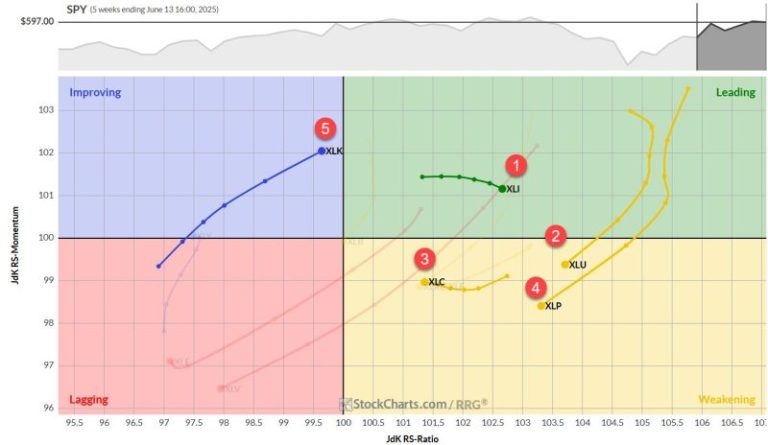
On the weekly Relative Rotation Graph, the Technology sector is showing impressive strength. Its tail is well-positioned in the improving quadrant, nearly entering the leading quadrant with a strong RRG heading. This movement explains Technology’s climb back into the top ranks.

Industrials remains the only top-five sector still inside the leading quadrant on the weekly RRG. It continues to gain relative strength, moving higher on the JdK RS-Ratio axis, while slightly losing relative momentum. All in all, this tail is still in good shape.

Utilities, Communication Services, and Consumer Staples are all currently in the weakening quadrant. Utilities and Staples show negative headings but maintain high RS-Ratio readings, giving them room to potentially curl back up. Communication Services is losing ground on the RS-Ratio scale but starting to pick up relative momentum.

Daily RRG: A Different Picture

Switching our focus to the daily RRG reveals a somewhat different story:

  • Industrials has moved into the lagging quadrant, losing ground on the RS-Ratio scale
  • Utilities and Staples are rolling back into the lagging quadrant with negative headings — not a great sign
  • Communication Services remains close to the benchmark
  • Technology shows the strongest tail, nearly completing a leading-weakening-leading rotation

This daily view underscores the strength we’re seeing in the Technology sector on the weekly timeframe.

Industrials: Facing Resistance

XLI dropped back below its previous high after a strong showing the week prior. There’s significant resistance between $142.50 and $145.

In a worst-case scenario, I think XLI could even retreat to the gap area between $137.50 and $139.

The uptrend remains intact, but more buying power is needed for a convincing break to new highs.

Utilities: Range-Bound

XLU is now trading in a range between roughly $80 on the downside and $83 on the upside.

It needs to break above the former high to continue building relative strength.

The raw RS line has returned to its trading range, dragging both RRG lines lower — not the strongest outlook for this defensive sector.

Communication Services: Testing Resistance

The sector peaked almost exactly at resistance offered by its previous high around $105, then closed at the lower end of the bar.

The raw RS line is managing to stay within its rising channel, albeit horizontally.

A sustained upward price movement is crucial for maintaining relative strength here.

Consumer Staples: Struggling to Break Higher

XLP continues to face heavy overhead resistance between $82 and $83.

Its inability to break higher is starting to hurt relative strength.

The raw RS line has moved down from a recent high, dragging the RRG lines lower.

The RS-Momentum line has already crossed below 100, positioning the weekly tail inside the weakening quadrant.

Technology: The Comeback Kid

XLK, the new kid on the block (again), tested its overhead resistance level around $244, peaking slightly above it last week before closing lower.

Recent strength has pushed the raw RS line convincingly higher, taking out its previous peak from mid-December.

Both RRG lines are pointing strongly upward, with RS-Momentum already above 100 and RS-Ratio rapidly approaching 100.

Portfolio Performance

With all this sector leapfrogging, especially involving the heavyweight Technology sector, the gap between the top five sectors’ performance and SPY has widened to around 7%.

The drawdown continues, but I’m sticking with this experiment and trusting the model to come back and start beating SPY again.

Yes, a 7% lag sounds significant (and it is), but it can change rapidly in such a concentrated portfolio. One or two strong weeks could easily turn this performance around, particularly if big sectors like Technology and potentially Consumer Discretionary become part of the top five.

#StayAlert and have a great week. –Julius


FMR Resources Limited (ASX:FMR) (FMR or Company) is pleased to announce it has entered into a conditional Binding Term Sheet giving it the right to earn up to a 60% interest in a highly prospective copper-gold-molybdenite project in central Chile (Transaction). The Company will joint venture (JV) into selected tenements (the JV Tenements or Concessions) within the Llahuin Project (Llahuin or the Project) held by Southern Hemisphere Mining Ltd (SUH) which overlie the Southern Porphyry Target.

Highlights

  • Large Cu-Au-Mo porphyry target untested at depth
  • Coincidental datasets suggest substantial copper porphyry system
  • Shallow historic drilling confirms porphyry mineralisation above target
  • Drilling of targets to commence early Q4 2025
  • Oliver Kiddie joins FMR as Managing Director
  • Firm commitments received for $2.2m capital raising at $0.16 through a placement to existing and new sophisticated investors
  • Mark Creasy to join the FMR register as major shareholder

The Southern Porphyry JV gives FMR exposure to a potential Company-making discovery. Coincidental datasets captured across the Southern Porphyry target area suggest a large, untested copper porphyry system below historic exploration. With proven fertility along a ~6km corridor at Llahuin, including historic shallow copper porphyry mineralisation directly above the Southern Porphyry target, this JV delivers FMR drill-ready targets for Q4 2025. The Company looks forward to updating shareholders as we progress towards maiden drilling of these exciting targets.

In conjunction, FMR is pleased to announce the appointment of Oliver Kiddie as Managing Director. Mr Kiddie is a geologist with over 20 years’ experience across exploration, resource definition, project development, and production throughout Australia and internationally. He has extensive experience in base metal and gold exploration through senior management, executive, and directorship positions, including Dominion Mining, European Goldfields, the Creasy Group, and Legend Mining.

Oliver Kiddie said:“I am very excited to be joining the FMR team as the Company expands its exploration portfolio with the Llahuin Project in Chile. I look forward to leading the Company through the next stage of growth and working with the experienced SUH team as the compelling Southern Porphyry drill targets are tested in Q4 this year, with the clear aim of a Company-making discovery.”

Project Description

Porphyry-style Cu-Au-Mo mineralisation identified to date at the Llahuin Project is largely hosted in three main mineralised zones – the Central Porphyry Zone, Cerro do Oro and Ferrocarril, which occur along a +2.5 km N-S strike (open north and south, with a total strike length of up 6 km). These zones are coincident with a north-south trending valley, potentially reflecting weathering of more regressive units or a structure.

Llahuin was initially acquired in July 2011 by SUH through an intermediary from Antofagasta plc. Drilling completed across the project to date comprises 296 holes for 64,503m with a total of 62 holes for 11,927m completed on the JV Tenements, of which 9,156m reports to the Ferrocarril zone and are therefore not relevant to the Southern Porphyry Target. Drilling has resulted in the delineation of Mineral Resources which do not form part of the JV and do not form part of the transaction (see Figures 1 and 7).

In addition to drilling SUH has completed extensive geochemical and geophysical surveys at Llahuin, including detailed magnetics (MAG), induced polarisation (IP), and magnetotellurics (MT). These datasets have indicated a “blind” porphyry-style target at the southern end of the Llahuin Project named the Southern Porphyry Target. This target is defined by a coincident magnetic anomaly, IP resistivity anomaly, and MT resistivity anomaly. The target is modelled as a circular feature 1.5km – 2km in diameter and centred approximately 1,000m below surface (see Figures 1, 2, 3, 4, and 5).

Click here for the full ASX Release

This post appeared first on investingnews.com

As an unprecedented Israeli attack on Iran last week sparks a spiraling conflict between the two enemy states, China has seen an opportunity to cast itself as potential peace broker – and an alternative voice to the United States.

Chinese Foreign Minister Wang Yi took up this mission over the weekend, speaking with both his Iranian and Israeli counterparts in separate phone calls, where Wang decried the attack that sparked latest conflict and telegraphed China’s offer to “play a constructive role” in its resolution.

“China explicitly condemns Israel’s violation of Iran’s sovereignty, security and territorial integrity … (and) supports Iran in safeguarding its national sovereignty, defending its legitimate rights and interests,” Wang said in a call Saturday with Iranian Foreign Minister Seyed Abbas Araghchi, according to Beijing’s official readout.

China’s self-described “explicit” opposition to Israel’s attack stands in sharp contrast to the country’s response to Russia’s invasion of Ukraine – which Beijing refused to condemn as it ramped up its close ties with Moscow.

It also underscores the hardening of geopolitical lines that have placed China in opposition to the US across a host of global issues.

Israel launched its aerial attack targeting Iran’s nuclear, missile and military complex early Friday in what Israeli Prime Minister Benjamin Netanyahu said was an operation to “roll back” the Iranian threat to his country’s survival.

Multiple waves of deadly assaults launched by both sides in the days since have seen mounting casualties and raised the risk of a broader regional conflagration that could involve the United States, which has so far only assisted in Israel’s defense against an onslaught on Iranian missiles and drones.

In Beijing’s eyes, all this gives ample reason to be outspoken on a conflict playing out in a part of the world where it has steadily worked to increase its own economic and diplomatic sway, but where experts say its heft as a powerbroker remains limited.

‘Play a constructive role’

For one, as the Trump administration’s “America First” policy has shaken up the US’ traditional position on the international stage, Beijing sees an opportunity to further expand its clout. That’s especially true in the context of countries across the Global South, where Israel has received stark condemnation over its ongoing assault on Gaza.

Beijing is also a key diplomatic and economic backer of Iran and has moved to further deepen collaboration in recent years, including holding joint naval drills, even as it’s sought to balance those ties with its growing relations with countries like Saudi Arabia. Chinese officials long voiced opposition to US sanctions on Iran and criticized the US withdrawal from the 2015 Iran nuclear deal, while accusing Washington of being a source of instability and tensions in the region.

Wang took veiled aim at the US in his call with his Iranian counterpart Saturday, according to the Chinese readout of the call, saying that “China also urges the countries that have influence over Israel to make concrete efforts to restore peace.”

“China is ready to maintain communication with Iran and other relevant parties to continue playing a constructive role in de-escalating the situation,” he added.

Speaking to Israeli Foreign Minsiter Gideon Sa’ar on Saturday, Wang said China “urged both Israel and Iran to resolve differences through dialogue” and added “that China is willing to play a constructive role in supporting these efforts,” a Chinese readout said.

Beijing is unlikely to see benefits from the deepening of tensions in the region, which it relies on for energy and where it has looked to show itself as an emerging powerbroker. For example, it took on a surprise role in facilitating a diplomatic rapprochement between archrivals Saudi Arabia and Iran in 2023.

It’s unclear what role Beijing could play in the resolution of the current conflict, including how much leverage Beijing has over Tehran, even as lawmakers in Washington have warned of a deepening “axis” between China, Iran, Russia and North Korea.

But when it comes to managing the direction of this escalation of an entrenched regional conflict, chances are that players both within the Middle East and the US – which plays a key role in regional security – will ultimately drive that effort.

Trump on Sunday posted on social media that Iran and Israel “will make a deal,” adding that “many calls and meetings” were “now taking place,” without providing details.

But the US president had also suggested another potential leader could have a role to play brokering peace: Vladimir Putin, with whom Trump said he discussed the escalating situation on Saturday.

In an interview with ABC News, Trump said he was open to the Russian leader, whose forces invaded Ukraine and who has resisted a US-brokered ceasefire in that conflict, serving as a mediator – another sign of the warming ties between Washington and Moscow, which maintains close relations with Tehran and has condemned Israel’s attack.

“I would be open to it,” Trump said. Putin “is ready.”

This post appeared first on cnn.com

For the past month Chinese aircraft carrier strike groups have been operating further from home shores and in greater strength than ever before, testing state-of-the-art technology and sending a message they are a force to be reckoned with, analysts and officials say.

Since early May, a People’s Liberation Army Navy (PLAN) flotilla led by the carrier Shandong has conducted exercises north of the Philippines; its newest carrier, the soon-to-be commissioned Fujian, has been on sea trials in disputed waters west of the Korean Peninsula; and its oldest carrier, the Liaoning has led exercises in the Pacific waters of Japan’s exclusive economic zone.

During the drills the Fujian for the first time conducted aircraft take-off and landing operations at sea using its advanced electromagnetic catapult system (EMALS), regional defense officials said.

That’s a significant development. Only one other carrier in the world has that system – the US Navy’s newest carrier, the USS Gerald R Ford.

Last Monday, the Japanese Defense Ministry said the Shandong and its support ships had been exercising in the waters southeast of the island of Miyako Island in southern Okinawa prefecture, putting two Chinese carrier strike groups in the open Pacific for the first time.

At the center of that box of exercises is Taiwan, the democratically ruled island claimed by China’s Communist Party despite never having controlled it.

Chinese leader Xi Jinping has vowed to “achieve reunification” with the island, using force if necessary.

Analysts noted that the Pacific exercises specifically covered areas through which US naval support of Taiwan, in the event of conflict there, would have to pass.

“The projection of power is beyond China’s own defensive needs,” the Taiwanese official said, unless it wants to assert the entire first island chain is its internal waters.

The first island chain stretches from Japan to the Philippines and further down to Indonesia as is seen as a strategically vital line to both China and the US.

Some analysts say Beijing may be laying the groundwork for that with so-called “salami slicing” tactics, or pushing its claims and presence in small but unrelenting steps until it’s too late for an opponent to stop them.

Besides Taiwan, the waters inside that first island chain include the Japanese-controlled Senkaku Islands, called the Diaoyus in China and, like Taiwan, claimed by it as sovereign territory.

Chinese maritime forces have been increasing their visibility around those islands. According to statistics from the Japanese Defense Ministry, more than 100 Chinese vessels have appeared in the contiguous zone of the islands – the waters between them – for all but one of the past 24 months.

Also within the first island chain are disputed islands in the South China Sea that have seen violent flare-ups between Chinese and Philippine forces as Beijing tries to aggressively assert its claim over geographical features in the waterway through which trillions of dollars in trade passes each year.

US Defense Secretary Pete Hegseth called out Beijing tactics at a recent defense forum in Singapore.

“Any unilateral attempt to change the status quo in the South China Sea and the first island chain by force or coercion is unacceptable,” Hegseth said in a speech at the Shangri-La Dialogue, noting the persistent PLA presence around Taiwan and harassment and intimidation tactics in the South China Sea.

“It has to be clear to all that Beijing is credibly preparing to potentially use military force to alter the balance of power in the Indo-Pacific,” Hegseth said.

Reaching well into the Pacific

While Hegseth focused on China’s activities inside the first island chain, the PLA Navy’s recent movements have it operating carriers beyond the second island chain, which runs from the Japanese main island of Honshu southeast to the US territories of Saipan and Guam and then southwest to Yap, Palau and New Guinea.

Japanese officials reported last week two Chinese carrier groups operating well out into the open Pacific.

“It is believed that China is planning to improve the operational capability of its aircraft carriers and their ability to conduct operations in distant areas of the sea,” Japanese Chief Cabinet Secretary Yoshimasa Hayashi said last Monday, noting that China has demonstrated for the first time the ability to operate a carrier in the waters east of Iwo Jima and close to Japan’s easternmost island Minamitorishima.

“The PLA is demonstrating a capability for sustained carrier ops outside of the first island chain. This is certainly a significant milestone for the PLAN,” said Ray Powell, director of SeaLight, a maritime transparency project at Stanford University’s Gordian Knot Center for National Security Innovation.

“Beijing is using the PLAN to signal its growing maritime power and willingness to use it,” said Carl Schuster, a former US Navy captain and Hawaii-based analyst.

A PLA Navy press release on Tuesday acknowledged the carrier activity in waters well out into the Pacific and emphasized that they are defense-minded.

“The Chinese Navy’s Liaoning and Shandong aircraft carrier formations recently went to the Western Pacific and other waters to conduct training to test the troops’ far sea defense and joint combat capabilities. This is a routine training,” the release quoted Chinese navy spokesperson Wang Xuemeng as saying, adding that the exercises are “not targeting specific countries.”

Overall, Schuster said China is making a very clear statement with the series of exercises.

“Although Beijing has characterized these activities as routine training and trials, its neighbors did not miss the related strategic message: China has become a major naval power that can and will apply that power in their waters if it chooses,” Schuster said.

New ships, new reach

Only one other naval power, the United States, has the capability to operate two or more carrier strike groups at such distances.

US Navy carrier strike groups usually consist of the carrier plus cruisers and/or destroyers equipped with the Aegis missile system to defend the prized asset at their heart.

Analysts noted the Chinese carrier groups in the Pacific have a similar formation and include some of the PLAN’s newest and most powerful surface ships, large Type 055 guided-missile destroyers as well as new but smaller Type 052DM destroyers.

With a displacement of around 12,000 tons, the Type 055s are considered by many naval analysts to be the most powerful surface combatants afloat and a centerpiece of what is now the world’s largest naval force, a title the PLAN took from the US Navy around 2020.

A report Tuesday in the state-run Global Times said the PLAN may be looking to operate carrier strike groups in all the world’s oceans like the US Navy does.

Chinese military affairs expert Zhang Junshe told the tabloid that Beijing’s expanding overseas business and cultural interests justify its naval expansion, including the ability of carriers to operate far from Chinese shores.

New carrier training may be seen in the Indian and Atlantic oceans, Zhang said.

The newest carrier

The Fujian, China’s newest aircraft carrier, is likely to be pivotal in the any PLA Navy plans to operate well out into the Pacific or other oceans.

Estimated to displace 80,000 tons, it’s believed to the largest non-American warship ever built and able to carry a fleet of about 50 aircraft, up from 40 on Liaoning and Shandong.

During its sea trials in the Yellow Sea last month, the Fujian conducted aircraft take-off and landing operations, according to South Korean defense officials.

The trials marked the first time a Chinese carrier had conducted such an activity inside the Provisional Measures Zone (PMZ), a disputed area where China and South Korea have agreed to both oversee fisheries management, but where friction between Beijing and Seoul persists.

The take-off and landing operations are significant as it marks the first time the Fujian has done so at sea, using its electromagnetic catapult system.

The system allows carrier aircraft to take off with heavier weapon and fuel loads than those operating off the Shandong and Liaoning, which feature ski-jump type take-off ramps, enabling Fujian’s aircraft to strike enemy targets from greater distances.

The Fujian is expected to carry the naval version of the J-35, a twin-engine stealth fighter jet that can’t operate off a China’s older carriers.

And China is building another carrier, for now known as the Type 004, which is expected to not only employ EMALS technology, but also – unlike Fujian but like the USS Ford – be nuclear-powered.

Nuclear power will extend the range of Chinese naval air fleet significantly because, as the carrier doesn’t need to be refueled, it can stay at sea longer and farther away from replenishment tankers.

“Beijing’s carrier program, like its fleet, is expanding and improving rapidly, not just with new ships but with new aircraft. That trend signals Beijing’s maritime intent,” Schuster said.

But even with the new equipment and expanded range, analysts expressed caution on overestimating the PLA Navy’s abilities.

Compared to the US, which has been operating carrier strike groups in the far seas for decades, China is very much at the beginning of the learning curve.

“China’s carrier force is still very much developmental at this stage. Still, China is closing the gap,” said Powell, the SeaLight analyst.

This post appeared first on cnn.com

Anne Wojcicki, the co-founder and former CEO of 23andMe, has regained control over the embattled genetic testing company after her new nonprofit, TTAM Research Institute, outbid Regeneron Pharmaceuticals, the company announced Friday.

TTAM will acquire substantially all of 23andMe’s assets for $305 million, including its Personal Genome Service and Research Services business lines as well as telehealth subsidiary Lemonaid Health. It’s a big win for Wojcicki, who stepped down from her role as CEO when 23andMe filed for Chapter 11 bankruptcy protection in March.

Last month, Regeneron announced it would purchase most of 23andMe’s assets for $256 million after it came out on top during a bankruptcy auction. But Wojcicki submitted a separate $305 million bid through TTAM and pushed to reopen the auction. TTAM is an acronym for the first letters of 23andMe, according to The Wall Street Journal.

“I am thrilled that TTAM Research Institute will be able to continue the mission of 23andMe to help people access, understand and benefit from the human genome,” Wojcicki said in a statement.

23andMe gained popularity because of its at-home DNA testing kits that gave customers insight into their family histories and genetic profiles. The five-time CNBC Disruptor 50 company went public in 2021 via a merger with a special purpose acquisition company. At its peak, 23andMe was valued at around $6 billion.

The company struggled to generate recurring revenue and stand up viable research and therapeutics businesses after going public, and it has been plagued by privacy concerns since hackers accessed the information of nearly seven million customers in 2023.

TTAM’s acquisition is still subject to approval by the U.S. Bankruptcy Court for the Eastern District of Missouri.

This post appeared first on NBC NEWS

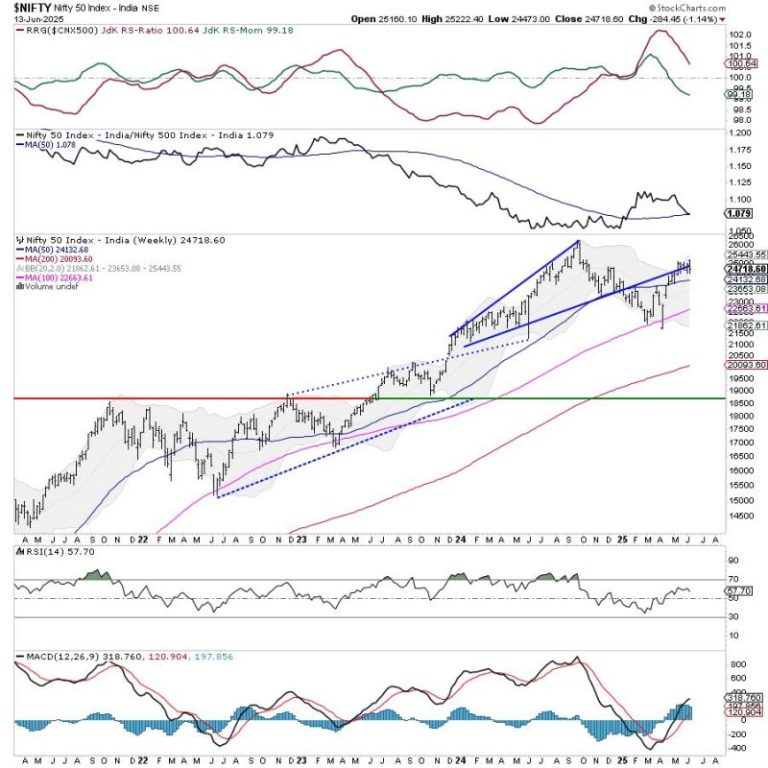
An attempt to break out of a month-long consolidation fizzled out as the Nifty declined and returned inside the trading zone it had created for itself. Over the past five sessions, the markets consolidated just above the upper edge of the trading zone; however, this failed to result in a breakout as the markets suffered a corrective retracement. The trading range stayed wider on anticipated lines; the Index oscillated in a 749-point range over the past week. The volatility rose; the India Vix climbed 3.08% to 15.08 on a weekly basis. The headline Index closed with a net weekly loss of 284.45 points (-1.14%).

We have a fresh set of geopolitical tensions to deal with Israel attacking Iran. The global equity markets are likely to remain affected, and India will be no exception to this. Having said this, the Indian markets are relatively stronger than their peers and are likely to stay that way. Despite the negative reaction to the global uncertainties, Nifty has shown great resilience and has remained in the 24500-25100 trading zone, in which it has been trading for over a month now. There are high possibilities that over the coming week, the Nifty may stay volatile and oscillate in a wide range, but it is unlikely to create any directional bias. A sustainable trend would emerge only after Nifty takes out 25100 on the upside or violates the 24500 level.

The levels of 25100 and 25300 are likely to act as resistance points in the coming week. The supports are likely to come in at 24500 and 24380.

The weekly RSI stands at 57.67; it stays neutral and does not show any divergence against the price. The weekly MACD is bullish and remains above its signal line.

The pattern analysis of the weekly chart shows that the Nifty has failed to break above the rising trendline resistance. This trendline begins from 21150 and joins the subsequent higher bottoms. Besides this, it reinforces the 25100 level as a strong resistance point. For any trending upmove to emerge, it would be crucial for the Index to move past this level convincingly.

Overall, it is unlikely that the Nifty will violate the 24500 levels. The options data shows very negligible call writing below 24500 strikes, increasing the possibility of this level staying defended over the coming days. Unless there is a situation with more gravity to be dealt with, the markets may stay largely in a defined trading range. The sector rotation stays visible in favor of traditionally defensive pockets and low-beta stocks. We continue to recommend a cautious stance as long as the Index does not move past the 25100 level and stays above that point. Until then, a highly stock-specific approach is recommended while guarding profits at higher levels.


Sector Analysis for the coming week

In our look at Relative Rotation Graphs®, we compared various sectors against the CNX500 (NIFTY 500 Index), representing over 95% of the free-float market cap of all the listed stocks. 

Relative Rotation Graphs (RRG) show that the Nifty Midcap 100 has rolled inside the leading quadrant and is set to outperform the broader markets relatively. The Nifty PSU Bank and PSE Indices are also inside the leading quadrant; however, they are giving up on their relative momentum.

The Nifty Infrastructure Index has rolled into the weakening quadrant. The Banknifty, Services Sector Index, Consumption, Financial Services, and Commodities Sector Indices are also inside the weakening quadrant. While stock-specific performance may be seen, the collective relative outperformance may diminish.

The Nifty FMCG Index languishes in the lagging quadrant. The Metal and Pharma Indices are also in the lagging quadrant, but they are improving their relative momentum against the broader Nifty 500 Index.

The Nifty Realty, Media, Auto, and Energy Sector Indices are inside the improving quadrant; they may continue improving their relative performance against the broader markets.


Important Note: RRG charts show the relative strength and momentum of a group of stocks. In the above Chart, they show relative performance against NIFTY500 Index (Broader Markets) and should not be used directly as buy or sell signals.  


Milan Vaishnav, CMT, MSTA

Consulting Technical Analyst

www.EquityResearch.asia | www.ChartWizard.ae

French President Emmanuel Macron is due to land in Greenland Sunday, in a move designed to bolster European support for the Danish territory, which is still batting away advances from the Trump administration to acquire it for the United States.

Macron will be the first foreign leader to visit the resource-rich island since US President Donald Trump began his campaign to buy or annex Greenland, which he insists the US needs for national security purposes.

A source at the Élysée Palace said that the French president’s trip had a “dimension of European solidarity and one of strengthening sovereignty and territorial integrity,” without mentioning the Trump administration’s threats to purchase Greenland, or take it by force.

Additionally, Macron’s visit would focus on Arctic security, climate change and Greenland’s economic development, the source added.

During his time on the world’s biggest island the French leader will tour a glacier, a hydroelectric power station and a Danish warship moored near the semiautonomous territory’s capital, Nuuk, per the Élysée.

“The deeps are not for sale, any more than Greenland is for sale, any more than Antarctica or the high seas are for sale,” Macron said on June 9 as he opened a United Nations conference on the oceans in Nice, France.

Trump’s intentions for Greenland can’t be far from the French president’s thoughts on his first visit to the Arctic territory, which Macron will conduct alongside Danish Prime Minister Mette Frederiksen and Greenland’s political leader, Jens-Frederik Nielsen.

French Foreign Minister Jean-Noel Barrot said in January that Paris had “started discussing (the deployment of French troops) with Denmark,” but that Copenhagen did not want to proceed with the idea.

Trump has repeatedly expressed interest in buying the island, or the US taking it by military or economic coercion, even as NATO ally Denmark and Greenland have firmly rejected the idea. Last month, the US president renewed his threat of using military force to annex the territory.

US Vice President JD Vance also made a stopover to visit American troops in Greenland in late March. During that trip, the vice president made a high-profile case for US control of the island. He said Greenland would be better off “coming under the United States’ security umbrella than you have been under Denmark’s security umbrella.”

In a move widely seen as an effort to ease American ambitions for the territory, on June 12 Denmark’s parliament widened a military agreement with Washington to allow US bases on Danish soil. US soldiers had previously been based at Danish facilities.

Denmark is also moving to bolster its military presence in Greenland, some 1,500 miles from the Danish mainland, including with fighter jets to patrol the western coastline toward the US and a navy frigate, per Greenland’s parliament.

This post appeared first on cnn.com

U.S. President Donald Trump said on Friday that concerns over national security risks posed by Nippon Steel’s $14.9 billion bid for U.S. Steel can be resolved if the companies fulfill certain conditions that his administration has laid out, paving the way for the deal’s approval.

Shares of U.S. Steel rose 3.5% on the news in after-the-bell trading as investors bet the deal was close to done. Trump, in an executive order, said conditions for resolving the national security concerns would be laid out in an agreement, without providing details. “I additionally find that the threatened impairment to the national security of the United States arising as a result of the Proposed Transaction can be adequately mitigated if the conditions set forth in section 3 of this order are met,” Trump said in the order, which was released by the White House.

The companies thanked Trump in a news release, saying the agreement includes $11 billion in new investments to be made by 2028 and governance commitments including a golden share to be issued to the U.S. government. They did not detail how much control the golden share would give the U.S. Shares of U.S. Steel had dipped earlier on Friday after a Nippon Steel executive told the Japanese Nikkei newspaper that its planned takeover of U.S. Steel required “a degree of management freedom” to go ahead after Trump earlier had said the U.S. would be in control with a golden share.

The bid, first announced by Nippon Steel in December 2023, has faced opposition from the start. Both Democratic former President Joe Biden and Trump, a Republican, asserted last year that U.S. Steel should remain U.S.-owned, as they sought to woo voters ahead of the presidential election in Pennsylvania, where the company is headquartered.

Biden in January, shortly before leaving office, blocked the deal on national security grounds, prompting lawsuits by the companies, which argued the national security review they received was biased. The Biden White House disputed the charge.

The steel companies saw a new opportunity in the Trump administration, which began on January 20 and opened a fresh 45-day national security review into the proposed merger in April.

But Trump’s public comments, ranging from welcoming a simple “investment” in U.S. Steel by the Japanese firm to floating a minority stake for Nippon Steel, spurred confusion.

At a rally in Pennsylvania on May 30, Trump lauded an agreement between the companies and said Nippon Steel would make a “great partner” for U.S. Steel. But he later told reporters the deal still lacked his final approval, leaving unresolved whether he would allow Nippon Steel to take ownership.

Nippon Steel and the Trump administration asked a U.S. appeals court on June 5 for an eight-day extension of a pause in litigation to give them more time to reach a deal for the Japanese firm. The pause expires Friday, but could be extended.

June 18 is the expiration date of the current acquisition contract between Nippon Steel and U.S. Steel, but the firms could agree to postpone that date

This post appeared first on NBC NEWS

On a recent evening in Kyiv, 4-year-old Olexander Reshetnik made a simple suggestion to his parents: “Let’s go to the parking garage now so we can sleep properly, and you don’t have to wake us up twice to take us there and back.”

The family lives on the 18th floor of a high-rise building and getting into the underground garage that doubles as a bomb shelter during Russian attacks is an uncomfortable experience. With aerial attacks becoming more common, it made sense to Oleksander to simply stay there.

Even at his young age, he knew the Russians would likely attack again.

His mother Khrystyna Reshetnik said the family has gotten used to seeing drones being shot down in the skies over Ukraine’s capital. In days gone by there would be one or two, maybe three, but things have changed.

Russia has ramped up its airborne attacks against Ukraine in recent weeks, launching as many as 479 drones and missiles in a single night. These assaults are not just bigger and more frequent; they are also more concentrated and executed in a way that makes them a lot more difficult to combat – as they are flown at higher altitudes, out of reach of machine guns.

Russia ramps up drone production

Russia successfully scaled up the domestic production of its most frequently used drone – the Iranian-designed Shahed – last fall and is now churning out hundreds of these killing machines every day.

Christina Harward, a Russia analyst at the Institute for the Study of War, said that according to current estimates, Moscow can now produce about 2,700 Shahed drones per month, as well as some 2,500 decoy drones.

The fact that some of the drones are decoys makes little difference to the Ukrainian defenses as Moscow has adapted them in a way that makes it very difficult to distinguish them from the real thing.

“So, either Ukrainian forces spend time trying to identify the decoys or they spend precious resources shooting them down. Either way, this helps the Russian missiles and Shaheds – with their large payloads – (as they) have the chance to get through to their targets,” Harward said.

The increased number of drones launched each night is overwhelming Ukrainian air defenses, especially since Russia began to zero in on handful of locations at a time.

On Monday night, it targeted the Ukrainian capital and the Black Sea port city of Odesa. The following night, it was Kharkiv, Ukraine’s second-largest city.

Russia maintains that it does not target civilians, but evidence to the contrary continues to mount. At least 154 Ukrainian civilians – including children – have been killed by drones, in Russian missile assaults and by artillery across the country in the last four weeks. A further 900 civilians have been injured.

The deadly attacks are designed to undermine Ukrainian morale and create the illusion that Russia has the upper hand in the war – even though Moscow is far from “winning.”

The front line in Ukraine has not moved in any significant way since Ukrainian forces liberated the southern city of Kherson in November 2023.

Russia has only managed to seize about 5,000 square kilometers (1,900 square miles) of Ukraine’s territory since then. Russian troops have advanced in some areas in eastern and northern Ukraine in recent months but have not managed to break through or take over a major city.

‘Impossible to shoot them down’

Yuriy Chumak spends many of his nights perched on Kyiv’s rooftops, machine gun in hand. A Supreme Court judge by day, he is part of a volunteer drone-hunting unit by night. He said the skies have gotten significantly busier in recent weeks.

He said after Moscow started flying drones at higher altitudes, it has become much harder, if not impossible, for his unit to destroy them.

Previously, Russian forces would fly the drones low, for example along a riverbed, to avoid being detected by Ukraine’s air defenses for as long as possible.

“The time to respond was very short because we only detected it when it was (close),” he said.

These days, he said, Russian drones are flying two to five kilometers (1 to 3 miles) above the ground.

“We can see them all. Radars can track them. But it has become impossible to shoot them down with machine guns,” Chumak said, adding that Ukraine now has to use missiles to thwart them.

But missiles are in much shorter supply. This is pushing Ukrainian forces to find new solutions on the go. Melnyk said that the efficiency of Ukraine’s air defense system remains remarkable. “Even now, about 80% of drones are being intercepted. A few months ago, this percentage was about 95. (But) we can see the impact of Russia increasing the number (of drones) and changing tactics,” he added.

Speaking to reporters last month, Ukraine’s President Volodymyr Zelensky praised the Ukrainian Air Force and volunteers like Chumak for pivoting as Russia ramped up its air war.

He added that Kyiv was now using drone-to-drone interceptors to combat the higher altitude bombardment. “We have the technology. The question is when we will be able to expand,” he said.

Zelensky said that Russia can produce some 300 to 350 drones a day, while Ukraine can only make 100.

“The issue is no longer about production capacity. It’s financial,” he said.

‘The norm for our children’

Kyiv mom Khrystyna Reshetnik said one of the worst things about the Russian aerial assaults is that they have become commonplace to her three boys, aged 4, 8 and 11. Olexander regularly asks whether the noise he hears is a Kalibr cruise missile or a drone.

“He’s just a little boy and he already understands what’s going on,” Reshetnik said. As the attacks have intensified in size and scope, the family has been spending more time in the underground parking garage, where Olexander and his two brothers sleep in the trunk of their car.

“This has become the norm for our children. It hurts my heart,” she said.

Yet despite the daily horrors they experience, the Reshetniks are among the lucky ones. They live in Kyiv, a city that is relatively well defended. The majority of the explosions they hear are Ukrainian air defenses intercepting Russian drones.

Many others elsewhere around the country are left without protective shields because Ukraine’s access to air defenses is limited by what its Western allies are willing to spare. Closer to the front lines, Russian troops have been using smaller drones to target civilians.

“There is (a) ballistic missile coming, so I am going to go into the shelter. My point is that this is the daily life of Ukrainian citizens and civilians.”

This post appeared first on cnn.com

Catching a sector early as it rotates out of a slump is one of the more reliable ways to get ahead of an emerging trend. You just have to make sure the rotation has enough strength to follow through.

On Thursday morning, as the markets maintained a cautiously bullish tone, I checked the New Highs panel on the StockCharts Dashboard, scanning the 1-, 3-, 6-, and 9-month highs list. A clear theme emerged—biotech and healthcare stocks dominated the shorter-term highs.

Seeing strength in healthcare and biotech, I checked the Market Summary BPI panel to compare breadth across sectors. Healthcare posted a 63.93% reading—an early sign the sector may be turning higher.

Comparing the broader sector with the biotech industry, the Key Ratios – Offense vs. Defense panel showed that Biotech outperformed Healthcare by a modest 2.31% over the past three months. This panel compares the SPDR S&P Biotech ETF (XBI), which represents the biotech sector, with the broader Health Care Select Sector SPDR Fund (XLV).

Are Biotech and Healthcare Starting a Bullish Rotation?

So, are we seeing an early rotation of both industry and sector toward the upside, and could either be shaping up as an opportunity for investment? Let’s take a comparative look at both relative to the SPDR S&P 500 ETF (SPY), our broad market stand-in.

Comparing XBI and XLV to SPY: Signs of Leadership?

FIGURE 1. PERFCHARTS OF XBI, XLV, AND SPY. This is typical of what you’d see during an early-stage rotation.

This PerfCharts view shows a one-year snapshot of relative performance, with biotech lagging behind healthcare, and both trailing the SPY in negative territory. Yet XBI and XLV are showing signs of recovery, with XBI exhibiting a sharper angle of ascent.

Seasonal Strength in Healthcare and Biotech Stocks

Now here’s an interesting addition to the current analysis: what if we considered the industry and the sector from a seasonality perspective? The reason for this is that certain sectors and the industries within them tend to exhibit recurring patterns of strength or weakness during specific times of the year. If we’re seeing a potential turning point in either, could a seasonality lens offer additional insight or clarity to the analysis?

Biotech Seasonality: Strong Months for XBI

Let’s start with XBI, and notice how it’s now entering a cluster of seasonally-favorable months.

FIGURE 2. SEASONALITY CHART OF XBI. The industry is entering a cluster of seasonally strong months.

According to this 10-year seasonality chart, June, July, August, and November tend to be strong months for XBI, with positive closing rates well above 50% (see figures above each bar) and higher-than-average returns (see figures at the bottom of the bars). Among them, June and November stand out as XBI’s strongest seasonal months.

XLV Seasonality: November Still Reigns

FIGURE 3. SEASONALITY CHART OF XLV.  According to this, July is XLV’s second-strongest month after November.

XLV’s seasonal profile shares a similar pattern, with a few key differences. July emerges as XLV’s second-strongest month, boasting a close rate of 89% and an average return of 3.1%. Like XBI, November is XLV’s top month in terms of average return.

What this tells us is that the biotech industry and the broader healthcare sector have historically performed well during these periods (especially November), suggesting that seasonal strength could serve as a tailwind if the current rotation continues to build momentum.

Charting the Rotation: XBI Trend Structure Shows Some Clarity

Next, let’s take a look at their current price action, starting with a daily chart of XBI.

FIGURE 4. DAILY CHART OF XBI. Notice how the trend structure is well-defined by the Fibonacci retracement, providing clear measurements for you to gauge the subsequent directionality once the market decides which way XBI will go.

XBI’s price action shows it reversed at the 50% Fibonacci Retracement level (November high to April low). Will the bears take control, or will XBI’s near-term reaction strengthen into an uptrend, eventually pushing XBI past the 61.8% retracement level, a threshold wherein bears may fold their positions and bulls increase theirs?

In light of the latter, the Relative Strength Index (RSI) is at 61 and rising, indicating room for upside, but only under the condition that the current bullish swing maintains its trajectory.

A few actionable tips. If you’re bullish on XBI and planning to add it to your portfolio, consider the following:

  • If XBI were to pull back deeper, watch to see if it bounces near the last recent swing low area at $76.
  • If XBI reverses to the upside, expect resistance at the 61.8% Fib retracement at around $91. Also, watch the yellow-shaded zone around $94, an area of concentrated trading activity which may also act as a strong resistance zone.

If XBI rotates in a bullish fashion, these key levels can help guide your analysis.

XLV Technical Setup: Strength, But Not Yet a Breakout

Next, shift over to a daily chart of XLV. You’ll notice it’s quite different despite also exhibiting a recovery.

FIGURE 5. DAILY CHART OF XLV. Unlike the previous example, XLV’s price action is more muddled.

XLV’s recovery doesn’t appear as convincing just yet, as it still needs to clear multiple swing highs and resistance levels clustered between $139 and $141 (highlighted in green). If it manages to break above this zone, the next resistance range—shaded in yellow—sits between $148 and $150. In short, the sector proxy faces several hurdles and technical headwinds ahead.

The RSI, at 58 and rising, is nowhere near overbought territory, but it may not immediately indicate bullishness unless XLV is able to establish an uptrend. For now, it isn’t clear if that will happen, so exercise caution.

From an actionable standpoint, the current technical structure doesn’t offer a clear entry setup. That’s largely because the trend lacks a well-defined sequence of higher swing highs and higher swing lows—something you’d typically look for when establishing favorable entry and exit positions.

At the Close

If healthcare and biotech are starting to rotate higher, XBI and XLV are the charts to watch. XBI shows a stronger trend structure, while XLV still faces resistance.  With seasonality on their side, add them to your ChartLists to track key levels and price action.


Disclaimer: This blog is for educational purposes only and should not be construed as financial advice. The ideas and strategies should never be used without first assessing your own personal and financial situation, or without consulting a financial professional.